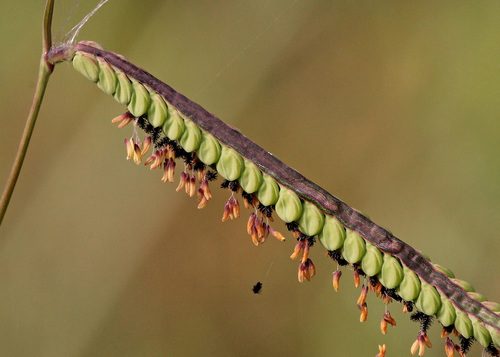
About Paspalum praecox Walter
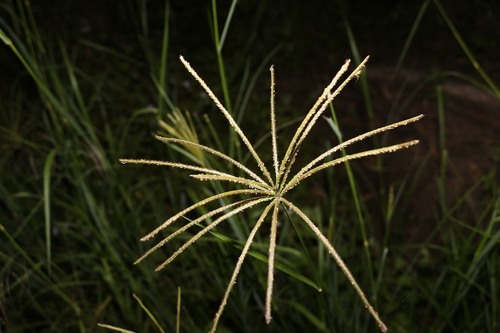
Paspalum praecox Walter has erect stems that grow between 60 and 90 cm (2 to 3 ft) tall. Its leaf blades have scaberulous margins, and can reach up to 20 cm (8 in) long, with a width of 1.5 to 4 mm (0.06 to 0.16 in). Individual plants produce 3 to 5 racemes, each 2 to 6 cm (0.8 to 2.4 in) long. Spikelets of this species are obovoid to suborbicular, relatively flat, and arranged in 4 rows, with a length ranging from 2.2 to 3.2 mm (0.09 to 0.13 in). The pedicels measure 0.1 to 1.1 mm (0.004 to 0.043 in) long. When mature grain forms, it is brown and reaches 2 mm (0.08 in) in length. This species has two varieties, which can be distinguished by the texture of their lower leaf sheaths: var. curtisianum has hirsute lower sheaths, while var. praecox has glabrous lower sheaths. Paspalum praecox is primarily distributed in the southeastern United States, where its range extends from Virginia to Florida, and west to Texas. There is a separate disjunct population of this species in Illinois, and it also grows in Cuba. Across its entire range, Paspalum praecox is classified as an obligate or facultative wetland hydrophytic species. It can be found growing in habitats including pine savannas, seepage areas, swamps, and wet woods.