About Paspalum conjugatum P.J.Bergius
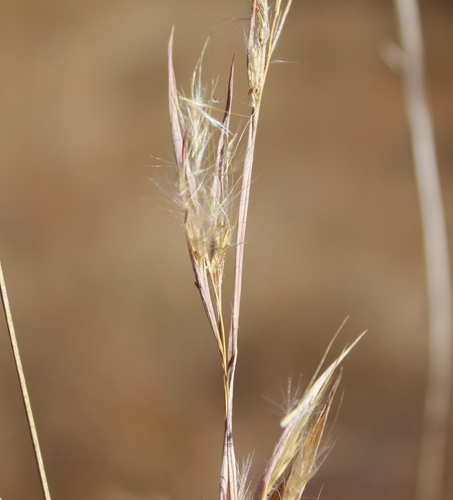
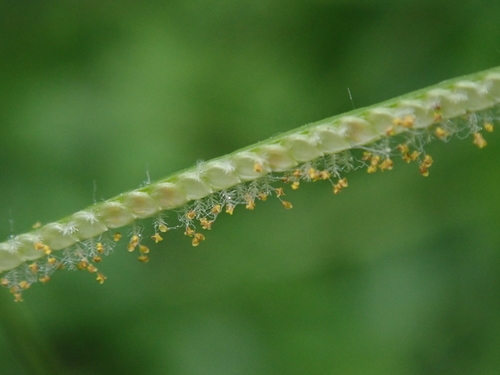
Paspalum conjugatum P.J.Bergius has a creeping, stoloniferous growth habit. Its culms are branching, slightly flattened dorsoventrally, and typically colored reddish to purplish. The leaf sheaths are strongly flattened, usually 30 to 50 mm (1.2 to 2.0 in) long, and hairy around the nodes. The leaves are smooth, about 8 to 20 cm (3.1 to 7.9 in) long and 5 to 12 mm (0.20 to 0.47 in) wide, shaped linear to lance-like and tapering to a point. Its inflorescences are characteristically T-shaped, with two (rarely three) racemes.
This species is native to the American tropics. It was introduced to tropical Southeast Asia and the Pacific Islands during the colonial period. It is especially abundant in the Philippines, where the English common name "carabao grass" originates (named after the carabao, the local water buffalo breed), and in Hawaii where it is called "hilo grass". It has also spread to Northern Africa, and northern and eastern Australia. In New Zealand, P. conjugatum was naturalized in 1977, and occurs on the Kermadec Islands, as well as at one mainland location near Rotorua.
Paspalum conjugatum grows at altitudes from sea level up to around 1,700 m (5,600 ft). It is most commonly found in riparian areas and disturbed habitats. It is usually unpalatable to cattle, particularly when it is in the flowering stage. When grown for forage, it is typically continually closely cropped to keep it palatable. It is suitable forage for water buffalos, which explains the common names "carabao grass" and "buffalo grass". It can become a serious weed in agricultural crop fields, and it is also grown as a lawn grass.