About Pasiphila plinthina Meyrick, 1887
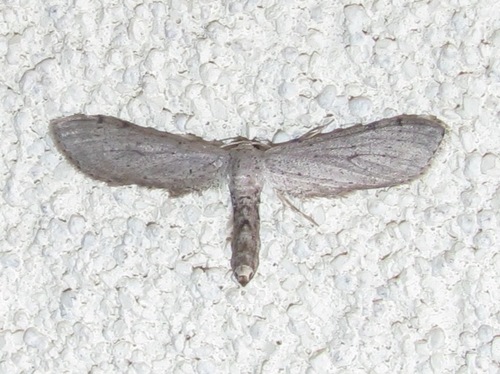
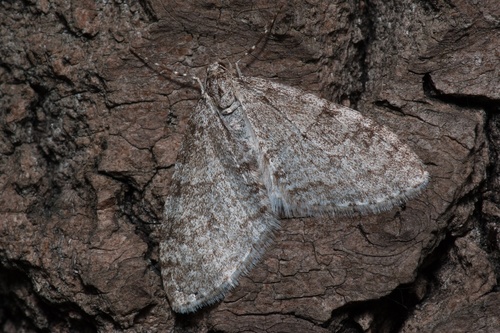
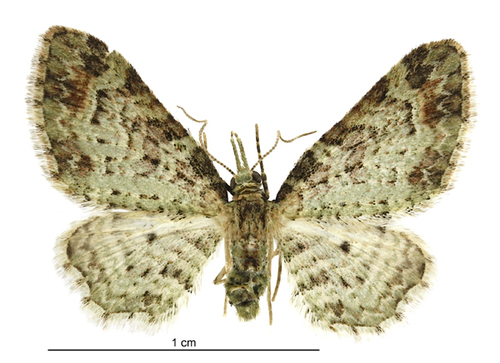
Meyrick originally described this species as follows: Male — 19 mm. Head, thorax, and abdomen are whitish-ochreous, dusted with reddish scales. Palpi measure 3, are whitish-ochreous, and are blackish towards the base on the underside. Antennae are whitish-ochreous, spotted with fuscous on the upper side, with ciliations 4 long. Legs are blackish, with the apex of each segment ochreous-whitish; the posterior pair of legs is entirely pale whitish-ochreous. The forewings have a very oblique hindmargin that is somewhat bowed, and slightly indented above the anal angle. They are whitish-ochreous, suffusedly dusted with reddish that tends to form very faint lines. There is a patch of blackish dusting on the basal quarter towards the costa. The edges of the median band are marked by a series of black dots on the veins; the anterior edge runs from 3⁄8 of the costa to 2⁄5 of the inner margin and is curved, while the posterior edge runs from before 3⁄4 of the costa to 2⁄3 of the inner margin, and is regularly curved across its upper two-thirds. A pale wavy subterminal line is preceded by a reddish fascia, which forms a darker red spot above the middle of the wing, another above the anal angle, and a blackish spot on the costa. A black hindmarginal line runs along the outer edge; cilia are ochreous-whitish, with an obscure reddish line, and have reddish-fuscous spots on the veins in the basal half. The hindwings have an unevenly rounded hindmargin, with the upper half rather deeply indented. They are pale whitish-ochreous, with obscure wavy reddish lines except towards the costa. A prominent black discal dot is present before the middle. The posterior edge of the median band and the subterminal line are more strongly marked. A blackish hindmarginal line is present, and cilia match those of the forewings. This species is similar in appearance to Pasiphila sandycias, and has been confused with that species in the past. It can be distinguished from P. sandycias by its longer palpi and more blurred forewing markings. This species is endemic to New Zealand, where it is found in the North Island, South Island, and Stewart Island.