About Pasiphila muscosata Walker, 1862
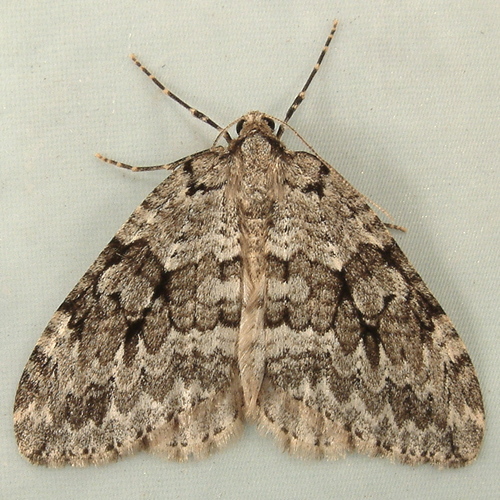
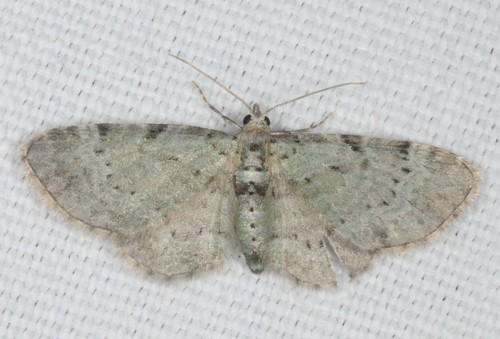
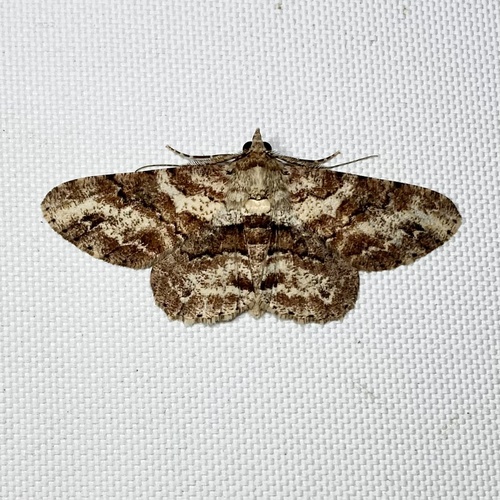
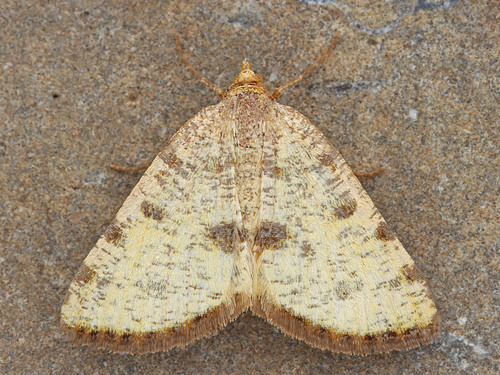
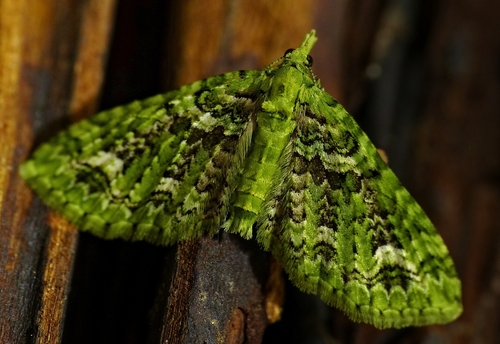
Pasiphila muscosata was first described by Walker in 1862, originally from the adult male of the species. Walker's original description reads: Male. Grass-green. Palpi porrect, shorter than the breadth of the head. Antennae slightly pectinated. Wings rather broad, with several denticulated blackish lines, which are most distinct and regular in the hind wings and are most conspicuous on the veins; submarginal line pale cinereous, zigzag; marginal line black, slender; fringe with black points. Fore wings hardly acute, with two indistinct paler bands, which are remote from each other; a black cloud between the second band and the submarginal line; exterior border convex, moderately oblique. Hind wings reddish cinereous. Length of the body 4 lines; of the wings 12 lines. This species is variable in adult appearance. Hudson described an orange-yellow ground colour variety of this moth, and noted that intermediate forms exist but are much rarer than the typical green form and the orange-yellow variety. Hudson also described the larva of this species: about 3⁄8 inch in length, considerably attenuated towards the head, with the segments strongly indented and the surface much wrinkled; its general colour is brown, or purplish-brown, with rich dark brown markings; there are humps on segments 6, 7, 8, 9 and 10, the largest on segment 8, each being much accentuated by a dark brown border; both extremities of the larva are clouded with dark brown, and there is a series of dark brown, or dark greenish-brown diagonal stripes. Like adults, larvae of this species are variable in colour and markings. Hudson hypothesized that the larva's appearance mimics the dried flowers of its host plants. This species is endemic to New Zealand, and can be found across the North Island, South Island, and Stewart Island. Larvae of this species feed on plant species in the genus Muehlenbeckia, as well as on Lophomyrtus bullata. They have been successfully reared in captivity on Muehlenbeckia australis. From late December to mid January, adult females lay their oval, flattened eggs, usually singly, on the leaves of host plants. Eggs hatch after approximately fifteen days, and turn dark in colour during the last few days before hatching. Larvae are typically present in January. They rest with their bodies held in a twisted shape, and have been observed swaying from side to side while walking. This species pupates in a loose cocoon on the ground. There appears to be only one brood per year. Adults can be found on the wing year round, but are most common from September to May. They are attracted to light. During the day, adults rest on tree trunks, where their appearance resembles moss, making the species extremely difficult to locate.