About Paryphanta busbyi (Gray, 1840)
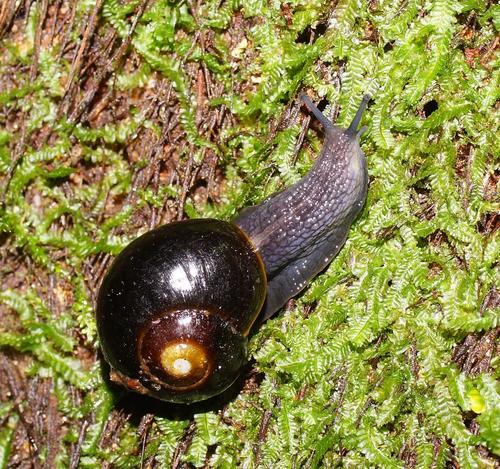
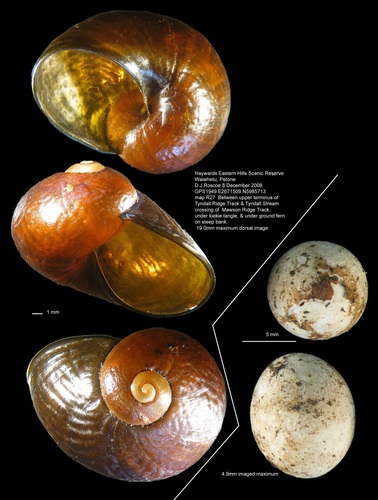
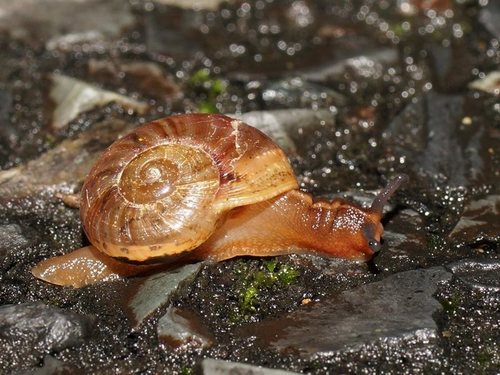
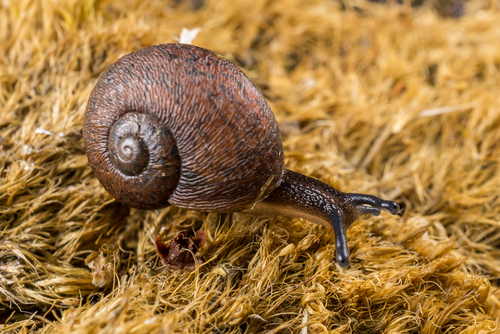
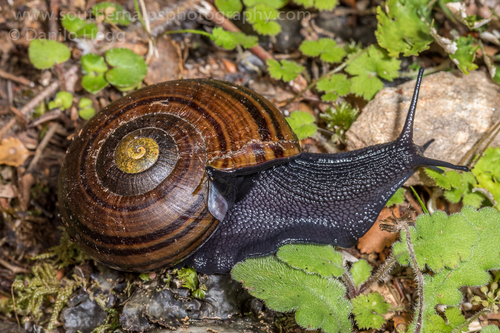
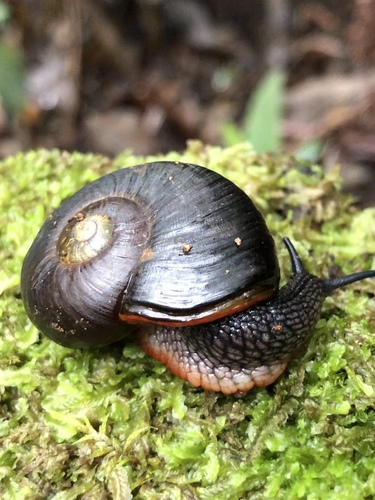
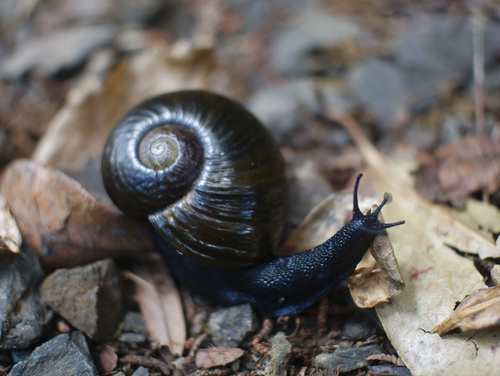
Paryphanta busbyi (Gray, 1840) is a large land snail with a distinct shell structure. The shell is large, broadly umbilicated, depressed, and subdiscoidal; it is opaque and shining, colored deep green usually marked with some radial blackish-green streaks. The nucleus of the shell bears a sculpture of oblique, arcuate radial plaits. The two succeeding whorls are distinctly rugose. More or less distinct spiral cords appear on post-embryonic whorls: these cords are first directed upwards, but become fully spiral on the last whorl. The plaits are distant, low, and broadly rounded, numbering between 5 and 10, and are absent from the shell base. Distant retractive growth-plications are present, and these are prominently and closely plicate at the suture. The entire shell surface is microscopically decussated by very fine, dense radiate and spiral lines; the spiral lines are slightly wavy. The periostracum is thick, glabrous, shining, and overhangs the peristome. The spire is flat, very slightly raised, and broadly convex. The protoconch has 2 flatly convex whorls, with volutions that increase rather rapidly. The full shell has 4½ rapidly increasing whorls. The last whorl is very large, slightly convex, with a rounded periphery and rounded base, and the body whorl is more or less deflexed anteriorly. The suture is well impressed. The inner aperture is shining-blue, and the aperture itself is obliquely lunate-oval. The peristome is simple, and inflexed along its entire length. The columella is very oblique, slightly arcuate, and shortly reflexed at its upper end. The umbilicus is broad, perspective, and deep. Adult shells measure 60–79 millimetres (2.4–3.1 in) in width and 33–44 millimetres (1.3–1.7 in) in height. The type specimen has a width of 66 millimetres, height of 29 millimetres, and a reported second width measurement of 53 millimetres (2.6 in × 2.1 in × 1.1 in). The shell of Paryphanta busbyi has a very thick periostracum and only a micrometre-thin calcium layer. If stored in a dry environment, the shell will break into pieces as the periostracum shrinks. The embryonic shell is globose, flat above, of 2 whorls, narrowed toward the base, and narrowly umbilicate; it measures 10 millimetres (0.39 in) wide and 9 millimetres (0.35 in) high. This species is native to the northern parts of New Zealand’s North Island, with recorded native localities including Kaitaia, Hokianga, Mangōnui, Bay of Islands, Otonga East, Mania Hill, Whangārei, Brynderwyn Range, Hen Island, Woodcocks, and Warkworth; Warkworth marks the southern edge of its native distribution. It has been introduced to additional localities: Little Huia in the Waitākere Ranges, Waiuku on the Āwhitu Peninsula, and the Kaimai Ranges. Its native range coincides with the distribution of kauri forest. The species’ type locality is New Zealand, and its type specimen is held at the Natural History Museum, London. These large snails inhabit leaf litter, ground-level plant growth, and areas under logs in kauri forests and shrubland. In some regions, they have been recorded occasionally occupying underground habitats, including burrowing deeply into soft soil. They are also found in shrublands dominated by the non-native species Hedychium, and in forests with non-native plants including Pinus radiata plantations. Paryphanta busbyi is typically active during cool, wet weather. Its activity is most strongly correlated with high humidity and still air, conditions that may help the snails track their prey. The snails retreat into daytime lairs when these are available, and are inactive during dry weather. This species is carnivorous and predatory, feeding on earthworms, insects, insect larvae, snails of the genus Rhytida, and conspecifics (cannibalism). Occasional individuals live in trees, most often in clusters of semiparasitic plants, where they can access their natural prey of earthworms. Females lay eggs in clusters of four to six at the foot of large trees, underneath dead leaves. Eggs are oval in shape, with inconsistent dimensions; they range from 10.5 by 9.5 millimetres (0.41 in × 0.37 in) or 12 by 9 millimetres (0.47 in × 0.35 in) up to 14 by 10.75 millimetres (0.551 in × 0.423 in). Eggs are white and limy, and lack a cuticle. A 1953 study found that it takes 7 years for the snail to grow to a shell width of 54 millimetres (2.1 in). A 2002 study recorded highly variable growth rates that are much higher than the rates reported in the 1953 study. The population density of Paryphanta busbyi is low compared to the related genus Powelliphanta.