About Parus major Linnaeus, 1758
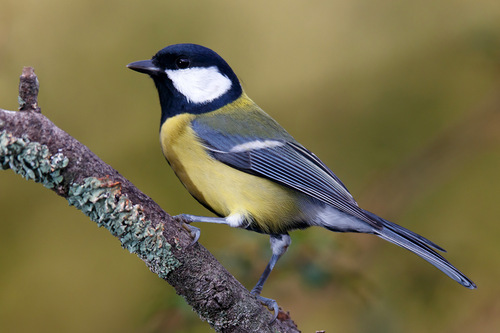
Parus major Linnaeus, 1758, the great tit, is a relatively large tit species, measuring 12.5 to 14 cm (4+7⁄8–5+1⁄2 inches) in length, and has a distinctive appearance that makes it easy to recognize. The nominate subspecies P. m. major has a bluish-black crown, black neck, throat, bib, and head, with white cheeks and ear coverts. Its breast is bright lemon-yellow, and a broad black mid-line stripe runs from the bib to the vent. There is a dull white spot on the neck that shifts to greenish yellow on the upper nape; the rest of the nape and back are green tinged with olive. Wing-coverts are green, while the rest of the wing is bluish-grey with a white wing-bar. The tail is bluish grey with white outer tips. Female great tits have plumage similar to males, but all colors are overall duller: the bib is less intensely black, as is the stripe running down the belly, which is also narrower and sometimes broken. Young great tits resemble females, but have dull olive-brown napes and necks, greyish rumps, greyer tails, and less defined white tips. There is notable variation across recognized subspecies. P. m. newtoni matches the nominate race, but has a slightly longer bill, slightly deeper green mantle, less white on tail tips, and a broader ventral mid-line stripe across the belly. P. m. corsus also resembles the nominate form, but has duller upperparts, less white in the tail, and less yellow on the nape. P. m. mallorcae is similar to the nominate subspecies, but has a larger bill, greyer-blue upperparts, and slightly paler underparts. P. m. ecki matches P. m. mallorcae except for having bluer upperparts and paler underparts. P. m. excelsus is similar to the nominate race, but has much brighter green upperparts, bright yellow underparts, and no or very little white on the tail. P. m. aphrodite has darker, more olive-grey upperparts, and underparts that range from more yellow to pale cream. P. m. niethammeri is similar to P. m. aphrodite, but has duller, less green upperparts, and pale yellow underparts. P. m. terrasanctae resembles the previous two subspecies but has slightly paler upperparts. P. m. blandfordi matches the nominate race, but has a greyer mantle and scapulars and pale yellow underparts. P. m. karelini is intermediate between the nominate race and P. m. blandfordi, and has no white on the tail. The plumage of P. m. bokharensis is much greyer overall, with pale creamy white to washed-out grey underparts, a larger white cheek patch, and a grey tail, wings, back, and nape. It is also slightly smaller, with a smaller bill but a longer tail. Two related subspecies in the Turkestan tit group share similar traits with P. m. bokharensis. P. m. turkestanicus is like P. m. bokharensis but has a larger bill and darker upperparts. P. m. ferghanensis matches P. m. bokharensis but has a smaller bill, darker grey on the flanks, and a more yellow wash on juvenile birds. Research has found that the intensity of yellow color on a male great tit's breast correlates with stronger sperm, making the color a signal of reproductive superiority to females. Higher carotenoid levels increase the yellow intensity of the breast, and also help sperm better resist damage from free radicals. Birds cannot synthesize carotenoids on their own, and must get these compounds from food, so a bright breast color demonstrates a male's ability to access good nutrition. However, the saturation of the yellow color is also affected by environmental factors such as weather conditions. Females select for the width of the male's ventral stripe, which varies between individuals, and higher quality females appear to prefer males with wider stripes. The great tit has a wide distribution across much of Eurasia. It occurs across all of Europe except Iceland and northern Scandinavia, including many Mediterranean islands. In North Africa, it lives in Morocco, Algeria, and Tunisia. It is also found across the Middle East, parts of Central Asia from northern Iran and Afghanistan to Mongolia, and across northern Asia from the Urals east as far as northern China and the Amur Valley. This species occupies a wide variety of habitats. It is most common in open deciduous woodland, mixed forests, forest edges, and gardens. In dense forests, including conifer forests, it prefers forest clearings. In northern Siberia, it lives in boreal taiga. In North Africa, it primarily resides in oak forests, as well as stands of Atlas cedar and even palm groves. In the eastern portion of its range, across Siberia, Mongolia, and China, it favors riverine willow and birch forest. The Turkestan subspecies live in riverine woodlands of willows and poplars, as well as low scrubland and oases; at higher altitudes, they occupy habitats ranging from dense deciduous and coniferous forests to open areas with scattered trees. Great tits are generally not migratory. Pairs usually stay near or within their territory year-round, even in the northern parts of the species' range. Young birds disperse from their parents' territory, but usually do not travel far. Populations may become irruptive during poor or harsh winters, meaning groups of up to a thousand birds may unpredictably move from northern Europe to the Baltic, the Netherlands, Britain, and even as far as the southern Balkans. The great tit was introduced to the United States but failed to become established after releases near Cincinnati, Ohio between 1872 and 1874. Proposals that great tits would effectively control codling moths nearly led to their introduction to new areas, particularly the United States, but this plan was never carried out. A small population is present in the upper Midwest, believed to descend from birds liberated in Chicago in 2002 alongside European goldfinches, Eurasian jays, common chaffinches, European greenfinches, saffron finches, blue tits, and Eurasian linnets, though sightings of some of these species pre-date this supposed introduction date. Great tits were introduced to Almaty Province, now part of Kazakhstan, in 1960–61 and became established, though their current status there is unclear. The Eurasian sparrowhawk is a known predator of great tits, with young from second broods facing higher risk, partly because sparrowhawks need more food to feed their own developing young. Great tit nests are raided by great spotted woodpeckers, particularly when the great tits nest in certain types of nest boxes. Other nest predators include introduced grey squirrels in Britain, and least weasels, which can even kill nesting adult great tits. A species of biting louse (Mallophaga), Rostrinirmus hudeci, was isolated and described in 1981 from great tits in central Europe. The hen flea Ceratophyllus gallinae is extremely common in the nests of both blue and great tits. It was originally a specialist flea of tits, but the dry, crowded conditions of chicken runs allowed it to thrive with this new host. This flea is preferentially preyed on by the clown beetle Gnathoncus punctulatus, while the rove beetle Microglotta pulla also feeds on fleas and their larvae. Although these beetles often stay in deserted nests, they can only breed at the elevated temperatures produced by brooding birds, and tits are their preferred hosts. Great tits compete with pied flycatchers for nesting boxes, and can kill prospecting male flycatchers. Fatal competition incidents are more frequent when the two species' nesting times overlap, and climate change has led to greater nesting synchrony between the two species, resulting in more flycatcher deaths. After killing flycatchers, great tits may consume the flycatchers' brains.