About Parus cinereus Vieillot, 1818
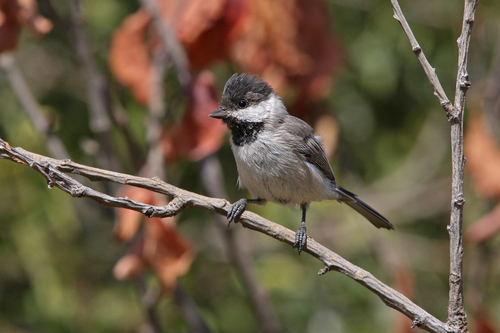
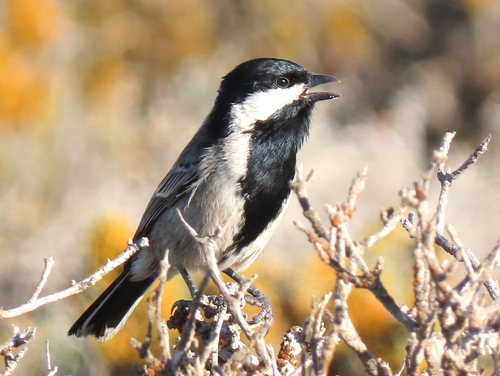
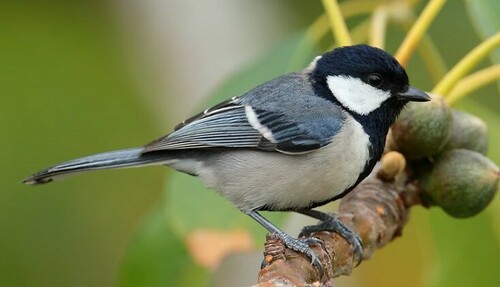
Like other species in the Parus genus, Parus cinereus has a broad black ventral line and lacks a crest. This tit species belongs to a complex of confusingly similar species, but can be distinguished by its grey back, black hood, white cheek patch, and white wing-bar. Its underparts are white, with a black central stripe running along their entire length. Females have a narrower ventral line and slightly duller plumage than males. The upper tail coverts are ashy, while the tail itself is black. The central four pairs of tail feathers have ashy outer webs, and all tail feathers except the central pair are tipped white. The fifth pair of tail feathers is white with a black rachis and a black band on the inner web. The outermost pair of tail feathers is entirely white, with only a black shaft. Undertail coverts are black toward the centre and white on the sides. Several subspecies that were formerly classified within Parus major are now placed in this species. All adult subspecies in this group have grey rather than greenish backs, though young birds show some green on the back and yellowish colour on the underside. These geographically separated populations differ mainly in the shade of grey plumage, the extent of white on the tail feathers, and body size. Size variation across populations is mainly clinal. These birds are typically seen in pairs or small groups, which sometimes join mixed-species foraging flocks. They forage primarily by gleaning, capturing disturbed insects, mainly caterpillars, bugs, and beetles, and they also feed on buds and fruits. They sometimes hold insects with their feet, then tear the prey apart with their beaks. They may also wedge hard seeds into bark crevices before hammering them open with their beaks, a behaviour that has been specifically noted in the subspecies caschmirensis. Their calls are whistled phrases such as titiweesi...titiweesi... witsi-seesee, or other similar variants, repeated three or four times followed by a pause. Calling is especially persistent during the breeding season. In playback experiments, both European Parus major and Asian Parus cinereus responded to each other's churring alarm calls, but the songs of European Parus major do not elicit much response from the Parus cinereus subspecies P. c. mahrattarum. A normal clutch contains about 4 to 6 eggs; a clutch size of 9 has been recorded for the subspecies caschmirensis, and one case has been documented of two Parus cinereus nests placed side by side. The breeding season occurs in summer, though exact dates vary across the species' range. Some pairs may raise more than one brood per breeding cycle. In southern India and Sri Lanka, the breeding season runs from February to May, mainly before the monsoons, but nests have also been observed from September to November. Nests are built in hollows in trees, or in hollows in walls or mud-banks, with a narrow entrance hole. The cavity floor is lined with moss, hair, and feathers. Parus cinereus sometimes reuses old nests originally built by woodpeckers or barbets. Both parents participate in incubation, and they hiss from inside the nest cavity when they feel threatened. They may also roost in natural cavities, including hollows in cut bamboo. The flea species Ceratophyllus gallinae has been recorded living in Parus cinereus nests from India.