About Parthenocissus tricuspidata (Siebold & Zucc.) Planch.
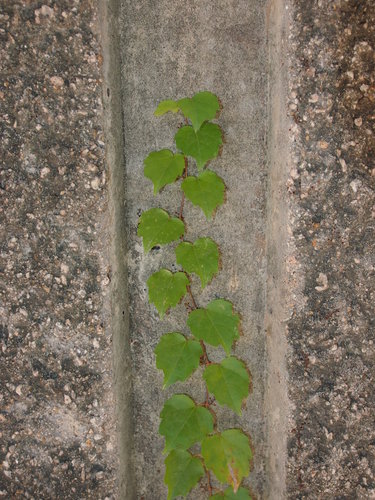
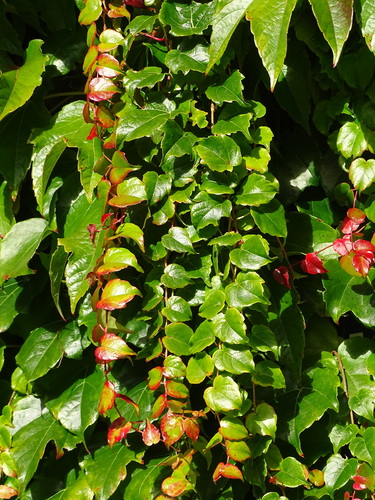
Parthenocissus tricuspidata (Siebold & Zucc.) Planch. is a deciduous woody vine that can reach 30 meters or more in height when provided with suitable support. It attaches itself to surfaces using numerous small branched tendrils tipped with sticky adhesive disks. Its leaves are simple, palmately lobed, most often with three lobes, though they may occasionally be unlobed, have five lobes, or be deeply enough lobed to appear palmately compound with typically three leaflets. Individual leaves measure between 5 and 22 centimeters across. The upper surface of the leaf blade is shiny and hairless, while the underside is dull green with only sparse hairs growing along the leaf veins. When new leaves bud, they have an initial reddish green to bronze color, and turn orange-yellow to deep scarlet in autumn. Stipules are present on this species. P. tricuspidata uses its adhesive pads to attach to surfaces, which lets it climb vertically up trees, walls, and other structures. When the pads make contact with a surface, this contact signals them to secrete mucilage through microscopic pores; this mucilage dries to form a strong, durable adhesive bond. The ability of a single adhesive pad to support thousands of times its own weight is being explored as a model for developing new biomimetic materials. Within its native range, the vine has traditional medicinal uses in China and Korea, and is used as a culinary sweetener in Japan. Both within and outside East Asia, the plant is primarily grown as an ornamental, and the cultivar 'Veitchii' is among cultivated varieties. Like the related Virginia creeper, P. tricuspidata is widely grown to cover the facades of masonry buildings. This use is economically important because shading walls in summer allows the vine to significantly reduce building cooling costs. Although the vine only attaches to building surfaces and does not penetrate them, surface damage such as scratched paint can occur when the plant is forcefully ripped away from a wall. In the United States, Boston ivy (the common name for this species) grows alongside Japanese bittersweet (Celastrus orbiculatus) on the brick outfield walls of Wrigley Field, home of the Chicago Cubs baseball team.