About Parthenocissus quinquefolia (L.) Planch.
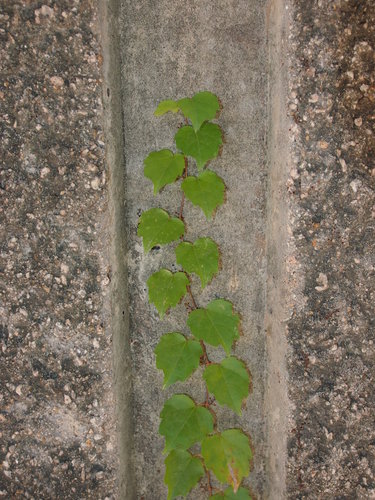
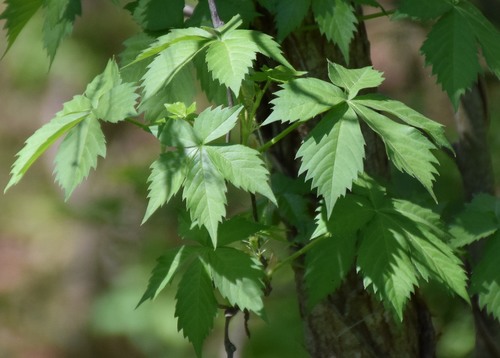
Parthenocissus quinquefolia (L.) Planch. is a prolific deciduous climbing vine that reaches 20 to 30 meters (70 to 100 feet) tall when growing in the wild. It climbs smooth surfaces with small forked tendrils, each tipped by a small, strongly adhesive pad that measures 5 mm (3⁄16 in) across. This species is grown as an ornamental plant, valued for its ability to quickly cover walls and buildings, and for its deep red to burgundy colored autumn foliage. It can be easily propagated from stem cuttings collected in spring. It is commonly found growing over telephone poles and trees. By shading the plants it grows over, it can limit their ability to photosynthesize, which may kill the covered plants. Its aggressive growth habit adds excess weight to slower-growing understory trees, causing damage to them. Its ability to spread through an extensive root system makes the species very hard to eradicate. Parthenocissus quinquefolia can be grown as a shading vine for masonry building walls. Like its close relative Parthenocissus tricuspidata (Boston ivy), this vine adheres to surfaces with its adhesive pads instead of penetrating roots, so it does not damage masonry. It also keeps buildings cooler in summer by shading the wall surface. Just like other types of ivy, pulling this plant away from a wall will leave its adhesive pads stuck to the surface. If the plant is clinging to a fragile surface, you can kill it first by cutting the vine away from its root; the adhesive pads will eventually break down and release their grip. This plant requires regular trimming to prevent it from spreading into unwanted areas. If it is allowed to grow into the walls of a frame house, it will continue growing upward inside the wall until it reaches a point where it can emerge.