About Parrotia persica (DC.) C.A.Mey.
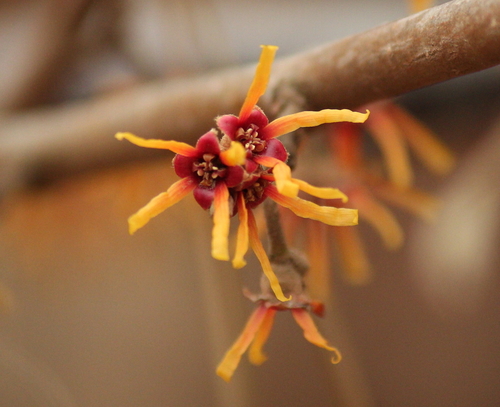
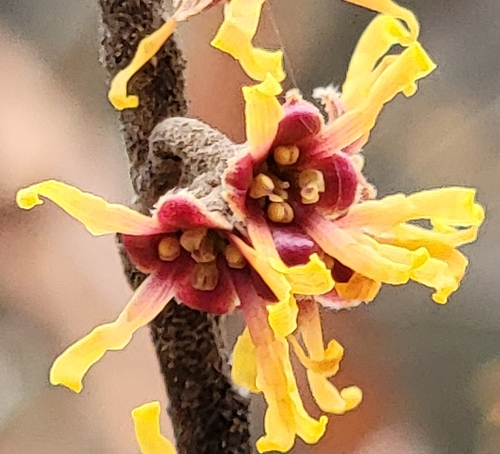
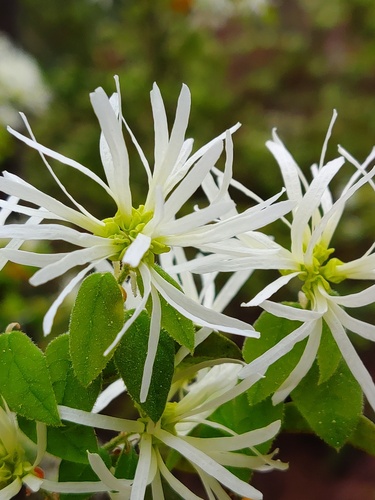
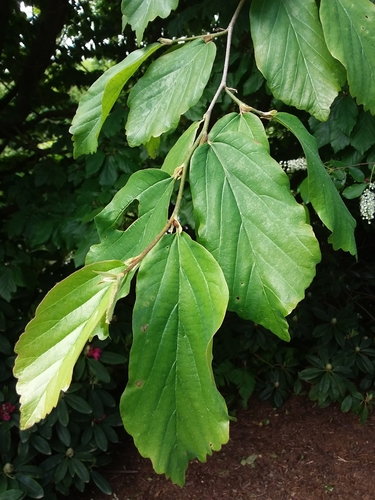
Parrotia persica (DC.) C.A.Mey. grows quickly when young. When mature in garden settings, it reaches 30 m (98 ft) tall and 8–15 m (26–49 ft) wide. It is naturally multi-stemmed and somewhat dense, but can be pruned to grow a single trunk up to 150 cm (59 in) in diameter. Its bark is smooth, pinkish-brown, and flakes or peels to leave a mosaic of cinnamon, pink, green, and pale yellow patches, similar to the bark of plane trees. Its leaves grow in an alternate arrangement, are ovoid in shape, and are often slightly lop-sided. They measure 6–15 cm (2–6 in) long and 4–10 cm (2–4 in) across, with wavy margins. The leaves are glossy green, and turn shades of rich purple, orange, and brilliant red in autumn, often with all these colours appearing on the same tree. The flowers are somewhat similar to witch-hazel flowers, but are dark red. Like witch-hazel flowers, they are produced in late winter on bare stems. They differ from witch-hazel flowers in only having four rounded sepals, with no petals. The stamens are fairly conspicuous, forming a dense red cluster 3–4 mm (1⁄8–3⁄16 in) across. The fruit is a two-parted capsule that holds two seeds, with one seed in each half of the capsule. Parrotia persica is cultivated as an ornamental tree, valued for its brilliant autumn colour and smooth, patterned bark. As an uncommon, drought-tolerant moderate-sized garden tree, it is prized for its striking autumn colour and the exfoliating bark that develops on mature specimens. Several cultivars have been selected for garden planting: 'Horizontalis' has a semi-weeping, wide-spreading horizontal branching pattern. 'Pendula' (Kew Form) is compact, weeping, and quite graceful. 'Select' has young leaves with purple margins, and is otherwise identical to the wild species. 'Vanessa' has an upright, columnar growth habit. The 'Vanessa' cultivar has gained the Royal Horticultural Society's Award of Garden Merit.