About Parotomys brantsii (A.Smith, 1834)
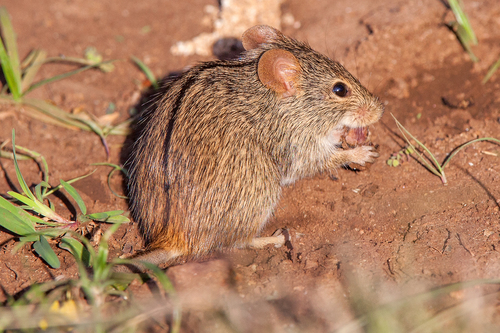
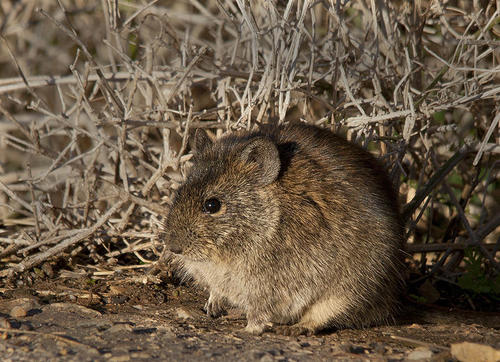
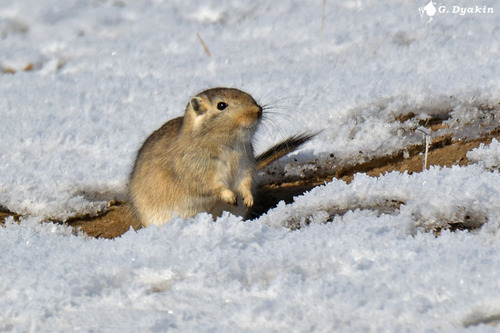
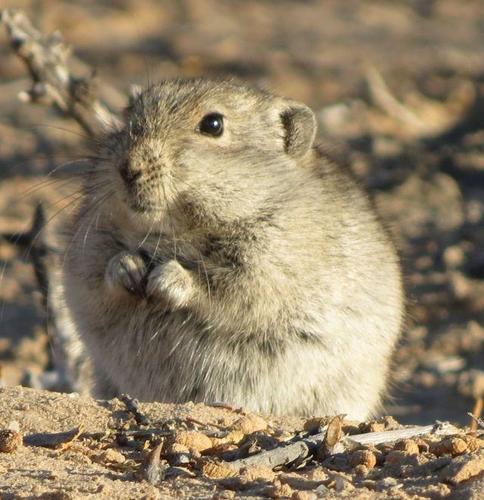
Brants's whistling rat, Parotomys brantsii, is a fairly large rodent species with a short, blunt head. Males have a head-and-body length of approximately 215 mm (8.5 in), and females are slightly smaller. The tail measures between 7.5 and 10.5 cm, which is about two thirds the length of the head-and-body. The head is greyish-white, with a rufous snout and forehead. Its ears are large and rounded, with dark skin and short hairs. The fur is dense and soft; the dorsal (upper) pelage is yellowish, speckled with brownish-black. Individual dorsal hairs have dark grey bases and yellowish tips, with a scattering of long, pure black hairs, especially along the spine. The flanks are rather paler than the back, and the ventral (underpart) pelage is pale grey, with individual hairs having pale grey bases and whitish or pale yellow tips. The legs are short; the feet have long, narrow claws, with four digits on the front feet and five on the hind feet. The tail is well-covered with hair, dark brown on the upper side and orangish-red on the sides and underneath. This rat lives in a complex burrow system with multiple entrances and several nesting chambers. In Namaqualand, these burrows occupy an average area of 73 m2 (786 ft2) and have an average of 93 entrances. Many of these entrances are in open areas, while others are in concealed locations. This arrangement helps the diurnal rodent take cover quickly when predators approach. When it spots potential danger, it gives a high-pitched whistling warning call: the call is brief for imminent threats such as a fast-flying bird of prey, and more prolonged for slow-moving threats such as a snake. Population size varies, with densities reaching over 50 individuals per hectare in favourable breeding seasons. Unlike some other species in arid environments, Brants's whistling rat has no special physiological adaptations to reduce water loss, and meets all its water requirements from the plant foods it eats. It is active when air temperatures are between 23 and 37 °C (73 and 99 °F), and burrow temperatures stay relatively stable even when outside temperatures change widely. It is most active in the early morning and the period near dusk, and stays underground during the hottest parts of the day. When possible, it forages from within the burrow, and rarely moves further than 30 cm (12 in) from a burrow entrance. Its diet consists of leaves, stems, grasses, succulents and bulbs, and does not include seeds or other dry materials.