About Paroaria gularis (Linnaeus, 1766)
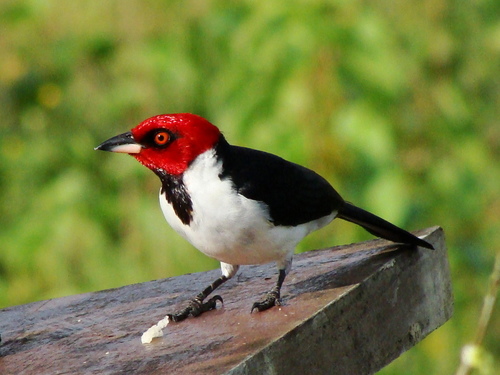
The red-capped cardinal, scientifically named Paroaria gularis (Linnaeus, 1766), has an adult body length of 16.5 cm (6.5 in) and an average weight of around 22 g (0.78 oz). The nominate subspecies has a crimson head, blackish lores and ocular region, and shiny black upperparts. A white partial collar extends up the sides of the neck, connecting to the bird’s white underparts. Its throat is black, and this black area extends to a point on the upper chest. The upper mandible of the beak is black, while the lower mandible is pale flesh-coloured. Its legs are dark grey, appearing almost black, and its iris is brownish-orange. Juveniles share the same overall plumage pattern as adults, but have dusky-brown upperparts instead of shiny black. Juvenile heads are deep brownish-buff, with darker colouring on the cap. Juveniles have an entirely black bill and a pale, dull creamy-yellow iris. The red-capped cardinal’s song is a variable, often repeated sequence of suweet-chu notes, and its call is a sharp chep. This species is found in the lowlands of the Guianas, Venezuela, eastern Colombia, eastern Ecuador, eastern Peru, northern and eastern Bolivia, and the Amazon basin in Brazil. In Brazil, the species appears to be largely absent from areas north of the northern bank of the Amazon River, except for populations in the relatively open lowlands of north-eastern Roraima and along the Branco River and lower Rio Negro. These northern regions are generally very poorly surveyed, so the species’ presence there cannot be ruled out, particularly in the area between the lower Rio Negro and Rio Jari, which forms the border between Pará and Amapá. The red-capped cardinal inhabits swamps, mangroves, várzea, and other semi-open areas located near water. It is generally common, and can even be found in lightly wooded wet habitats within towns or cities, such as Manaus and Puerto Maldonado.