About Paroaria coronata (J.F.Miller, 1776)
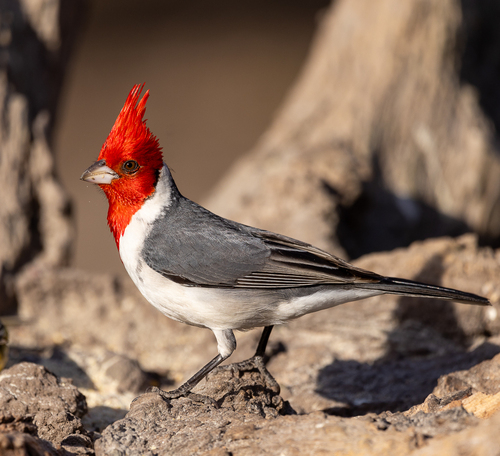
The red-crested cardinal, scientific name Paroaria coronata (J.F.Miller, 1776), is a medium-sized bird. Adults have a red head, a red bib, and a short red crest that the bird raises when excited. The belly, breast, and undertail are white, while the back, wings, and tail are gray. Wing coverts are gray, but the primaries, secondaries, and rectrices are a darker shade of gray. Juveniles resemble adults, but have a dull brownish-orange head and bib. This species is very similar to its close relative, the red-cowled cardinal Paroaria dominicana. It is also similar to the yellow-billed cardinal Paroaria capitata, but the yellow-billed cardinal differs by having a black throat, darker upper parts, and a bright yellow bill. This species is native mainly to Rio Grande do Sul in Brazil, the southern Pantanal, northern Argentina, Bolivia, Paraguay, and Uruguay. It has been introduced to Hawaii, Puerto Rico, and Chile, and to multiple locations outside its historical range within Brazil, including Tietê Ecological Park in São Paulo. Its natural habitats are subtropical or tropical dry shrubland and heavily degraded former forest, found at elevations up to 500 metres (1,600 ft) above sea level. It often lives close to rivers, marshes, and lakes. This species feeds mainly on seeds of Chloris virgata, Eleusine tristachya, Setaria parviflora, and Spergula villosa, fruits of Celtis tala, Grabowskia duplicata, Holmbergia tweedii, Morus alba, and Sapium haematospermum, insects, and small arthropods. It generally forages on the ground in pairs or small groups. Its average lifespan is about 3.8 years.