About Parnassius stubbendorfii Ménétriés, 1849
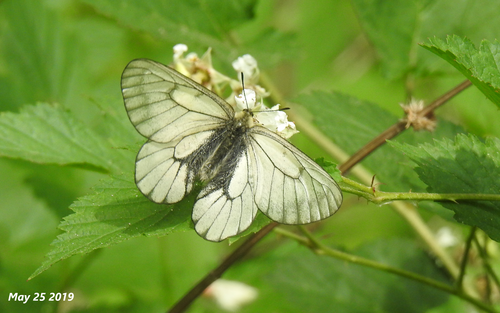
This species, Parnassius stubbendorfii Ménétriés, 1849, has a dull white base color with black veins. The forewing has a narrow grey band along the costal edge, and broader transparent grey coloring covering the apex and distal margin. A more or less distinct dark grey shadowy transverse band appears near the apex, and two grey spots are present in the cell, which are sometimes absent. The hindwing is almost entirely patternless, with only the abdominal border lightly dusted with black; the underside sometimes has yellow hairs along the abdominal margin. The female's sphragis pouch is whitish, and similar in appearance to that of Parnassius mnemosyne. Antennae, legs, and wing fringes are all black. Occasional female specimens are darkened entirely grey or blackish across the whole body, just as seen in the previous species; this variant is named ab. melanophia Honr. On this dark ground color, the markings of the aberration are indistinct or entirely absent, and the abdomen is thinly covered with yellowish hairs. In the subspecies Parnassius stubbendorfi tartarus Austaut, 1895, female individuals have intensified grey markings. The cell spots are more distinct, connected to each other and to the costal spot beyond the cell apex via grey dusting along the sides of the cell. The forewing's submarginal band is more distinctly marked, and more or less abundant blackish scaling dusts both sides of the veins on both wings. A grey spot is generally present at the costal margin of the hindwing. This subspecies is found in Kuku-nor, Sining, and Kashmir. The larva of Parnassius stubbendorfii is conspicuously different from that of all other Parnassius species, and resembles a large Agrotis caterpillar. Young larvae are black with pale yellow oblique side stripes. After the final moult, larvae become light red-brown, with two pale yellow longitudinal stripes that bear black spots. Additional black markings including dashes, lines, and arrowhead-shaped spots appear on the back. The underside and sides up to the yellow stripes are greyish brown, and the underside has numerous pale dots. The head and thoracic legs are black. The entire body is covered in short hairs, and the reversible osmeteria fork is whitish yellow and nearly transparent. Larvae are active in May and June, feeding on Corydalis species, especially Corydalis gigantea, and stay concealed during the day. The pupa develops inside a rather strongly constructed cocoon, which is placed under old pieces of wood, stones, and similar objects, as documented by Graeser. Parnassius stubbendorfii is distributed in the Altai Mountains, Amurland, and Ussuri, which are the eastern Asiatic coastal provinces. Identification of Parnassius butterfly species is often difficult, and sometimes can only be done through dissection of the genitalia. P.R. Ackery (1975) provides an identification key that is available online.