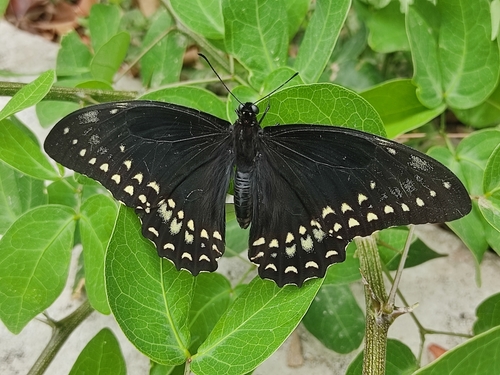
About Parnassius smintheus Doubleday, 1847
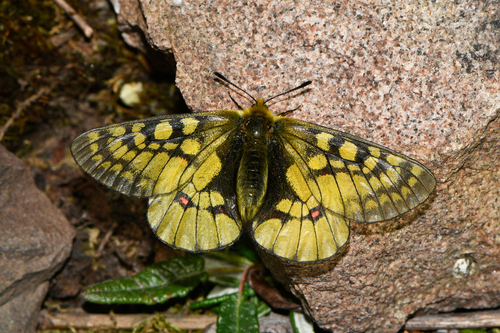
Parnassius smintheus, commonly called the Rocky Mountain parnassian or Rocky Mountain apollo, is a high-altitude butterfly found in the Rocky Mountains across the United States and Canada. It belongs to the snow Apollo genus (Parnassius) of the swallowtail butterfly family (Papilionidae). Its wing color ranges from white to pale yellow-brown, with red and black markings that signal to predators that the butterfly is unpalatable. As larvae, Parnassius smintheus feeds primarily on the leaves of Sedum lanceolatum, and as adults it feeds on this plant’s nectar. This butterfly lives mostly in meadows and avoids forests, because it strongly prefers light. Males of this species fly frequently from meadow to meadow to find females and food resources, while females are far less likely to fly. Males of this species exercise mate choice: they emerge from pupae earlier than females and patrol for females, strongly preferring newly emerged females that have not yet flown. Though the species is not currently endangered, climate change and human activity over recent decades have reduced its available viable habitats, and this habitat loss continues. The butterfly’s range centers on the Rocky Mountains, spanning Canada and the United States. This range includes mountainous areas of Yukon, Alaska, and British Columbia in Canada, and extends as far south as New Mexico in the United States. P. smintheus is most often found in alpine and subalpine meadows. Males of this species prefer meadows that have greater abundance of nectar flowers, a higher amount of their host plant Sedum lanceolatum, and more females of their own species. Males may visit two or more meadows to gather information on each meadow’s relative quality. Researchers have suggested this male preference for meadows with more food resources stems from their higher energy requirements, because males spend much more time flying than females. In contrast, female butterflies show no preference for meadows with more nectar flowers or host plants, or meadows with greater numbers of males. The primary larval host plant is Sedum lanceolatum, spearleaf stonecrop, a yellow-flowered perennial succulent common in rocky habitats across Western North America. Less frequently, larvae may feed on other stonecrop species, including S. divergens, S. oreganum, S. stenopetalum, and S. integrifolium. These foodplants tend to grow most abundantly on steep, well-drained, gravelly slopes, and they are mostly found 20–40 meters above the tree line. Large herbivores rarely feed on S. lanceolatum because the plant produces a deterrent cyanoglycoside called sarmentosin, so larvae have little risk of being accidentally preyed on when they consume this foodplant. Larvae also sequester the sarmentosin from the plant in their own bodies for their own defense. If S. lanceolatum becomes physically damaged by mechanical means, larvae feeding on this damaged plant show reduced growth rates, which may be caused by an induced defensive response from the plant. Insect damage to the plant does not trigger this defense, but damage from larval feeding does induce the plant’s defensive response. As a result, larvae feed quickly and move to a different host plant within the window when the plant still offers the highest nutritional quality. Typically, larvae feed on a plant and leave it in less than half an hour. From November to February, the leaves of their foodplant are fatally toxic to larvae, but larvae feed and develop normally during the rest of the year. If snow melts before March, eggs hatch while the larval foodplant is still toxic, and the larvae die.