About Parnassius phoebus (Fabricius, 1793)
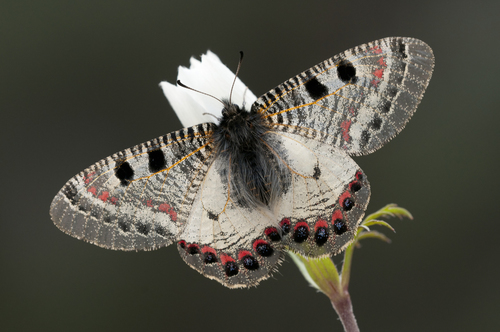
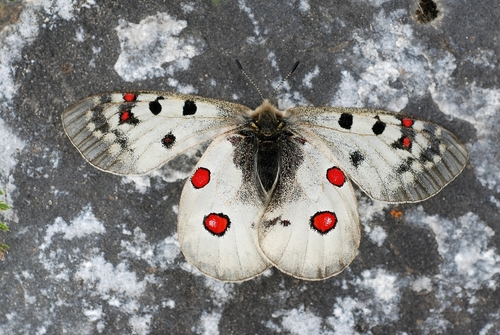
Parnassius phoebus was first described by Fabricius in 1793. Males of this species typically have forewing costal spots with no red; the anterior spot sometimes has a white pupil. The forewing submarginal band is faint, and is either abbreviated or interrupted, with no spot at the hind margin. On the hindwing, red ocelli are usually small, and there is sometimes a submarginal row of faintly marked black spots. The veins often feature distinct, elongated black punctures. Females have more clearly defined, more extensive markings than males. On the forewing, the vitreous margin is separated from the submarginal band by large, uniform white spots. The second costal spots often have a red pupil, are connected to each other by black scaling, and sometimes have blackish shadows on the disc. The hindwing has a greyish vitreous marginal band, and distinct contiguous submarginal half-moons that form a complete band. It also has two larger red ocelli; the posterior ocellus occasionally has a white pupil. Anal spots are sometimes more intense, and one of them is filled in with red. This species inhabits mountains between 1,600 and 2,800 meters above sea level, most commonly between 1,800 and 2,200 meters. It occupies humid, damp, wet locations, including mountain stream edges, areas near springs and fresh seepages, and small snow valleys (Schneetälchen). Its habitat selection aligns with the preferences of its caterpillar food plant.