About Parnassius mnemosyne (Linnaeus, 1758)
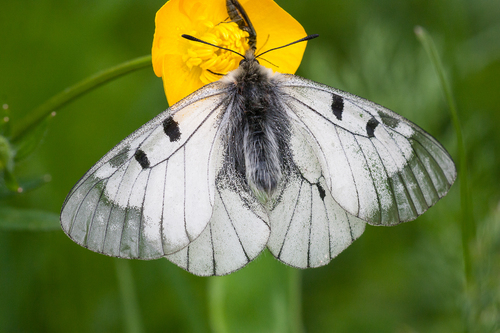
This species is scientifically known as Parnassius mnemosyne (Linnaeus, 1758). For its wing morphology: the wings are white, with thin black veins and blackish fringes. The forewing has two black cell-spots. In males, the distal margin from the apex to approximately the middle is transparent-grey; in females, this transparent-grey area extends further down the margin and is broader. The hindwing is dusted with black from the abdominal margin to the cell and at the cell apex, with denser black dusting in females than in males.
The antenna, legs, and abdomen are all black. In males, the abdomen is covered with whitish hairs; in females, the abdomen is nearly naked and glossy, and bears a whitish bladder-like pouch that occupies almost two-thirds of its underside. This species generally shows very little variation. A rare aberration where the forewing cell-spots are connected by a black streak is named ab. halteres Mosch. A form darkened by dense black dusting is described as ab. melaina Honr., this form occurs especially often in females, and is found scattered among typical individuals of the species, with particularly frequent occurrence in Carinthia, Carniola, the area surrounding Vienna, Wallis (Valais), Transylvania, and Austrian Silesia.
A conspicuously small local form, minor Reb. & Rog., occurs around Friesach in Carinthia at elevations between 630 and 750 m; this form has reduced black spots on the forewing, with a wing expanse of only 52 mm. In Bavaria and Salzkammergut (Berchtesgaden) around 1000 m altitude, where the species flies in June to July, a stable melanotic form called hartmanni Stgr. has developed. In male hartmanni, an additional grey costal spot sits between the apical cell-spot and the widened, dull blackish transparent marginal band, and the abdominal border of the hindwing is broader with denser black dusting. Female hartmanni follow the same darkening pattern as ab. melaina, but are usually less dark; they have a very broad transparent forewing border, and sometimes a grey S-shaped shadowy transverse band extending from the costal spot seen in males. On the hindwing, they have a more intensely colored band-like marking behind the cell that extends forward from the abdominal border, plus 1 or 2 costal spots.
The form athene Stich. inhabits Greece (Chelmos, Olenos). It has a row of 4 or 5 whitish spots in the moderately broad transparent border of the forewing, which tapers sharply posteriorly. Otherwise it closely matches typical Parnassius mnemosyne, but has slightly stronger markings, placing it midway between typical individuals and the next described form. nubilosus Christ. (10 f) is the race from Northern Persia and the Caucasus. The white spots in its widened marginal border are more distinct, usually forming a submarginal band of 7 or 8 wedge-shaped or luniform spots. Black markings are intensified and enlarged, and males have a grey abbreviated band on the forewing between the apical cell-spot and the transparent border, plus an additional grey spot at the forewing hind margin. The hindwing has extensive black dusting beyond the cell, forming a band-like marking. An enlarged variant of this race from Central Asia (Kuldja, Alai), with even more intensified black markings and a wider transparent border, is named gigantea Stgr. (10f); specimens of this race with a slightly yellowish ground color are called ab. ochracea Aust.
The egg of this species is conical and whitish. The larva is cylindrical, tapering at both ends, black, covered in short hairs, and marked with orange spots across the body. Larvae feed in April and May on Corydalis species, most commonly Corydalis halleri, C. cava, and C. solida, and remain concealed during the day. Pupation takes place underground in a loose cocoon; the pupa is thick, obtuse, hoary, and luteous.
The species' distribution ranges from the Pyrenees, across the Central Massif, the Alps, and the Carpathians, reaching as far as central Asia. It occurs across all European countries including Norway, where it is rare and restricted to certain locations. A subspecies that occurred in Denmark is now extinct. Many geographical races and individual forms have been recognized across this large range. The most notable forms include the dark race hartmanni from the eastern Bavarian Alps, and the dark-colored form melaina which has the most pronounced darkening. A 2013 paper by Dr. I.N. Bolotov and colleagues summarizes data on the northern localities of Parnassius mnemosyne, most of which are located within the Russian Federation, and provides a detailed description of the species' northern range limits. This work shows that the northernmost existing populations are found in karst landscapes in the north of the White Sea-Kuloi Plateau (between 65°35' and 66°03' N) in the downstream sections of the Soyana and Kuloi rivers, and in the north of the Timan Highland (66°10' N) along the shore of Kosminskoe Lake in the Pechora River basin. The northern limits of the clouded Apollo's range appear to be strongly determined by the distribution of its larval host plants, primarily Corydalis solida, while climate and relief appear to play a less important role. Many Russian populations are located within state nature reserve territories: Kizgi Scerries Reserve (Republic of Karelia), Pinega and Soyansky reserves (Arkhangelsk Oblast), and Pechoro-Ilychsky and Belaja Kedva reserves (Komi Republic).