About Parnassius glacialis Butler, 1866
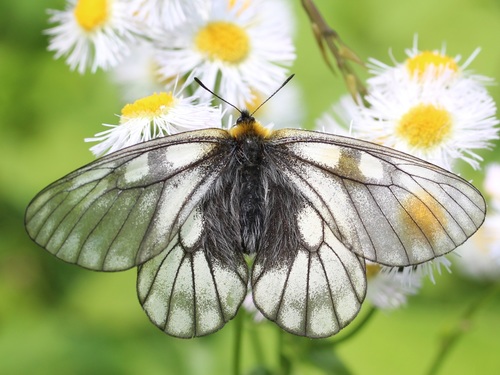
This species, scientifically named Parnassius glacialis Butler, 1866, is much larger than Parnassius stubbendorfi, the species it was once classified under as a subspecies, per description from Takashi et al. 2001. The blackish grey central spot on its wing cell is sometimes connected to the apical cell-spot by fuscous dusting along the cell sides. The submarginal band of its forewing is more or less distinct and complete. The abdominal area of its hindwing is deep black extending to the cell, covered in white hairs, with blackish dusting on and along the veins. The collar, coxae, and lateral side of the abdomen are covered in yellow or reddish yellow hairs. The underside of the wings is slightly yellow. In some specimens collected from Hakodate, Japan, the cell-spots and submarginal band of the forewing have disappeared entirely, or are only faintly visible. Butterflies in the Parnassius genus are often difficult to identify, and in some cases can only be definitively identified through dissection of the genitalia. This species is distributed in eastern China, Korea, and Japan. Its type locality, designated via lectotype, is recorded as "Hakodadi (North Japan)". Hakodadi lies near the southern limit of Hokkaido.