About Parnassius eversmanni Ménétriés, 1855
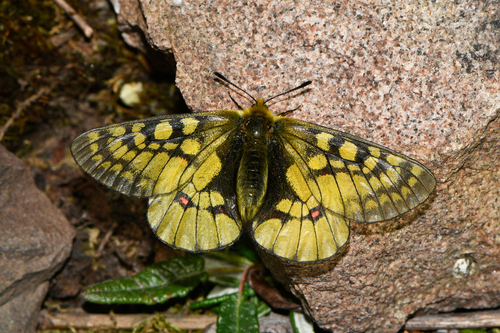
Identification of Parnassius eversmanni Ménétriés, 1855 is difficult and uncertain. The wing pattern of all Parnassius species is inconsistent, and the group has very many subspecies and forms. Structural traits from genitalia, wing venation, the sphragis, and foretibial epiphysis are more reliable than wing pattern, but not fully reliable. The description below is only a guide; for an identification key, see Ackery P.R. (1975). Males have a yellow wing ground-colour, while females have yellow or yellowish-white ground-colour. This species' wing pattern very closely resembles that of female Parnassius felderi. On the forewing, the base and costal margin are grey, and the distal margin has a greyish gloss. Beyond the cell is a curved grey-shaded discal band, and a similar sometimes less distinct submarginal band. On the hindwing, the abdominal area is dusted with black. There is a spot at the anal angle, which occasionally (especially often in females) extends into a short band. A more or less distinct undulate submarginal band is also present. Additionally, there are two red ocelli; the posterior ocellus is sometimes entirely black on the upperside, or missing entirely, but always remains distinct on the underside. The upperside of the hindwing base is spotted with red. The head and body are covered in yellow hairs. The larvae of this species feed on multiple Corydalis species: C. gigantea, C. pauciflora, C. arctica, C. paeoniiholia, and C. gorodkovi.