About Parnassius clodius Ménétriés, 1855
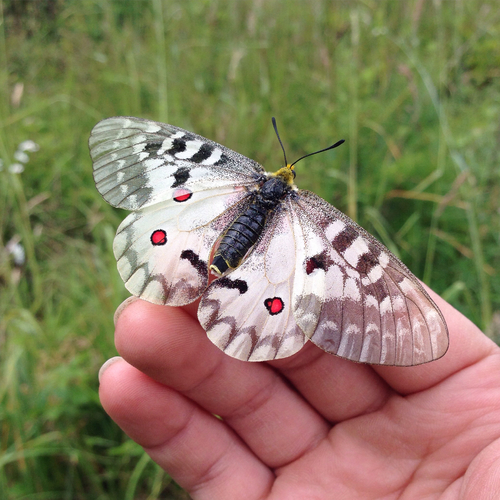
This species is scientifically named Parnassius clodius Ménétriés, 1855. Wing pattern across Parnassius species is inconsistent, and the large number of Parnassius clodius subspecies and forms makes identification problematic and uncertain. Structural characteristics from the genitalia, wing venation, sphragis, and foretibial epiphysis are more reliable for identification than wing pattern, but not entirely reliable. The description provided here serves only as a guide; an identification key for this genus can be found in Ackery P.R. (1975). For Parnassius clodius, the base wing color is white. Only in females is the short costal band located outside the wing cell connected to the hindmarginal spot by an irregular dusty band. The glossy submarginal band of the forewing is sharp but narrow. Males have small crescent-shaped submarginal spots on the hindwing, while females have larger ones. On the hindwing, the anal spot is most often centered with red. This species is found in western North America, specifically in British Columbia, Washington, Oregon, Nevada, and California.