About Parnassius apollo (Linnaeus, 1758)
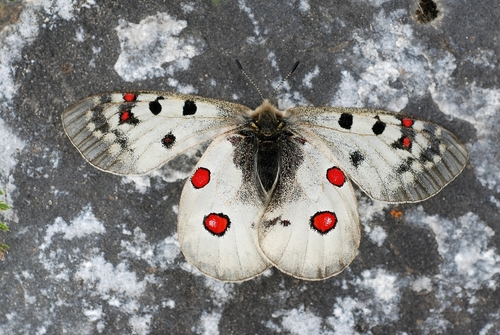
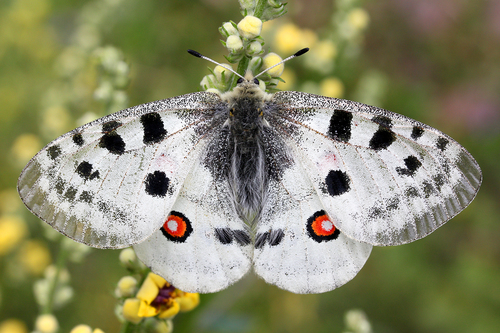
Parnassius apollo (Linnaeus, 1758), commonly called the Apollo butterfly, shows the following size differences between sexes: males have a wingspan of 62–86 millimetres (2.4–3.4 in), while females have a wingspan of 65–95 millimetres (2.6–3.7 in). This species has a great deal of individual variation in appearance, with clear colour polymorphism. These are very large, beautiful, conspicuous white butterflies decorated with five large black eyespots on the forewing and two bright red (or sometimes orange) eyespots on the hindwing. The size and form of these striking red eyespots vary based on the butterfly’s geographic location, and the bright red colour often fades in sun exposure, making the eyespots of older individuals appear more orange. The wings are shiny, with slightly transparent edges; some individuals are darker, a trait called sphragismelanism that is common in many butterfly species. The caterpillars of this species are velvety black with orange-red spots along the sides. Related Parnassius species are found worldwide. The clouded Apollo (Parnassius mnemosyne) lives in valleys, while the small Apollo (Parnassius phoebus) occurs in high mountain habitats. The small Apollo has strongly marked black and white antennae, and has two red spots near the apex of its forewings.
This is a mountain butterfly species that prefers hills and flowery alpine meadows and pastures of continental European mountains, with populations in Spain, Scandinavia, Central Europe, the Balkans up to northern Greece, and the Alps between Italy and France. It is also present in some areas of central Asia, specifically Sakha. As a species typical of high altitudes, its mountain habitat ranges from 400 metres (1,300 ft) up to 2,300 metres (7,500 ft), and it is far more common above 1,000 metres (3,300 ft). The species requires specific climatic conditions: cold winters and sunny summers. It also requires wide open spaces, with shrub cover less than 5% and at least 50% of the area covered by lawns. The presence of the caterpillar host plant is critical for this species.
Pleistocene climate change forced separation of Parnassius apollo populations, which contributed to the distinct colour variation seen in the species. During the glacial period, Parnassius apollo populations became divided and isolated across the Eurasian region. Large glaciers created physical barriers that prevented interaction between population groups. Isolated populations migrated westward into parts of southern Europe, where they settled and reproduced. There is variation in wing colour alleles between these isolated populations, and there is also variation in population size. Larger separated populations occur in habitats that can support more resources. These larger populations are called metapopulations, and together with smaller separated sub-populations, they form a mainland-island system. Parnassius apollo can migrate between habitats, which creates additional variation within each isolated population. New environmental pressures select for better-suited colour variants within these isolated populations. Variation in the species correlates with extinction risk: environments with high variation see greater numbers of extinctions. For example, high variation in the Swiss Alps corresponds to a high current rate of extinction for this species. One probable cause of extinction is climate warming. Parnassius apollo is described as an "atypical glacial invader", and warming climates in mountain regions mean the species cannot easily adapt to these changed conditions. Another possible cause of extinction is linked to the distribution of nectar plants. If migration between patches of nectar plants is blocked, Parnassius apollo populations will slowly decline and reproduction may stop. This is because outcrops where nectar plants grow are the species’ mating sites, and if these sites are too far apart for butterflies to migrate between them, population dynamics are put at risk.
This species has a single brood per year. Adult Apollo butterflies fly from May to September, and feed on flower nectar. During mating, males deposit a gelatinous secretion called a sphragis on the female’s abdomen, which prevents the female from mating a second time. Females lay eggs that overwinter and hatch the following spring. Apollo caterpillars are velvety blue-black with small orange spots. These caterpillars feed on stonecrop (Sedum species, mainly Sedum telephium, Sedum album, Sedum rupestre and Sedum ropsea), Hylotelephium caucasicum, and houseleek (Sempervivum species). When fully grown, caterpillars pupate on the ground, forming a loose cocoon, and the adult butterfly emerges after metamorphosis.