About Parnassia asarifolia Vent.
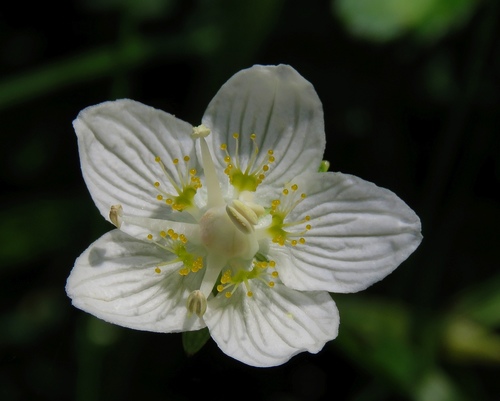
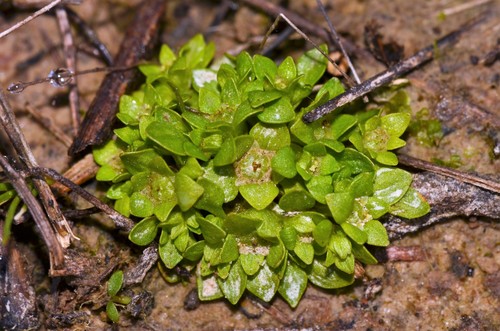
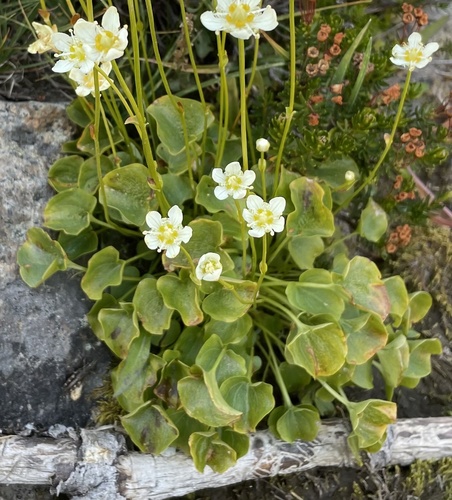
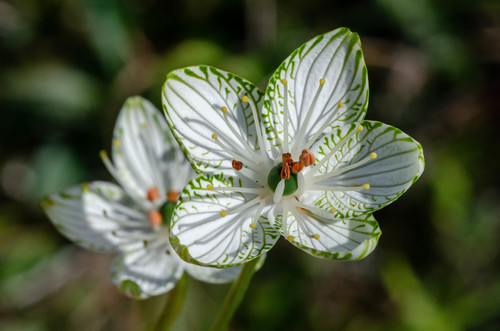
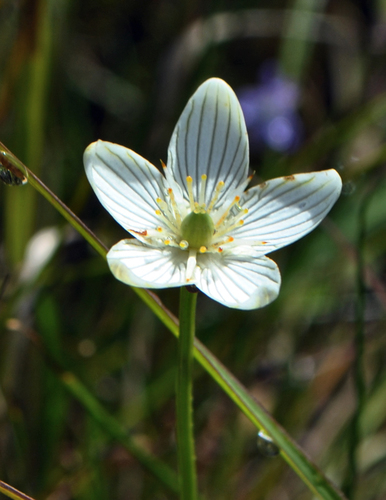
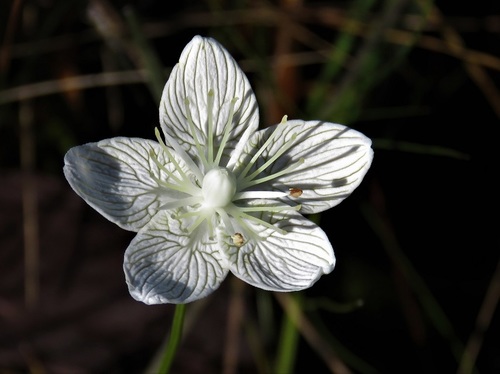
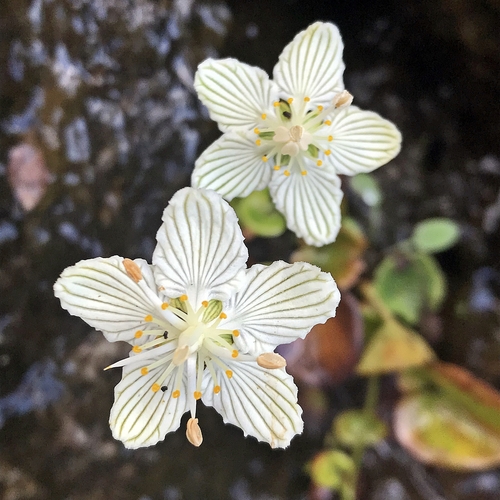
Parnassia asarifolia Vent. is a perennial wildflower herb with an erect green stem 18 to 50 centimeters long, bearing a single white flower at its apex. Flowers bloom from July to October, and fruits develop from September to November. Most leaves are basal, arranged in a rosette, and each attaches to a petiole 6 to 17 centimeters long. Larger leaves are broadly reniform to reniform-orbiculate, usually wider than they are long, with a cordate base and rounded apex. When present, cauline leaves grow on the middle to lower portion of the stem. During fruiting, the flower's small sepals bend backward (are reflexed); sepals are oblong to slightly egg-shaped, with narrow translucent margins. Petals are much larger than sepals, measuring approximately 10 to 18 millimeters long and 7 to 11 millimeters wide. They are oval to elliptic in shape, with visible green translucent veins, and each of the five petals narrows into a short claw-like shape at its attachment point to the flower. A key distinguishing feature of the species is its set of five nonfunctional stamens, called staminodes, which are shorter than the five fertile stamens. The species also has one pistil with a single superior white-greenish ovary and four stigmas. Parnassia asarifolia is distributed across the southern Appalachian region and surrounding areas, including Alabama, Arkansas, Georgia, Kentucky, Maryland, North Carolina, South Carolina, Tennessee, Texas, Virginia, and West Virginia. It grows in boggy or swampy habitats such as fens, wet woods, rocky banks, and mountain bogs, most commonly in acidic loam or sand, in full sun to partial shade, at elevations between 700 and 4900 feet. This species occurs in year-round moist wetland habitats and thrives in acidic soil with a pH below 6.0. As a long-lived species restricted to specialized habitats, P. asarifolia is sensitive to hydrological changes and habitat disturbance. Its populations are typically localized and sparse, which reflects its dependence on stable, acidic, saturated soil. While specific pollinators for this species have not been documented, other members of the genus Parnassia generally rely on insect pollination, as insects are attracted to fake nectar droplets on the sterile staminodes, so P. asarifolia is thought to share this pollination method. There is no documented medicinal use for this species, but it is used in landscaping for native gardens in regions where it is naturally found. As a specialized species, it is sometimes cultivated by gardeners in bog or wet garden settings. It grows best in consistently moist to wet acidic soil, specifically loam or sand, matching its natural adaptation to bogs, seeps, and wet woodlands. It requires partial sun, which is 2 to 6 hours of direct sunlight per day, to full sun, which is 6 or more hours of direct sunlight per day. It depends on stable hydrology to survive, as it is sensitive to drying or changes in soil moisture.