About Parmentiera aculeata (Kunth) L.O.Williams
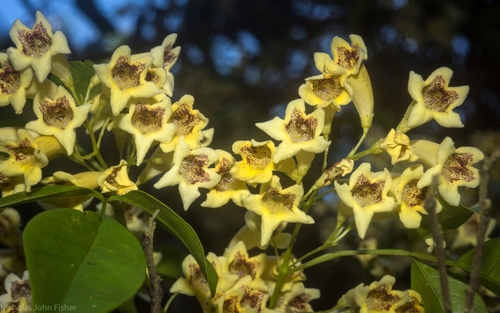
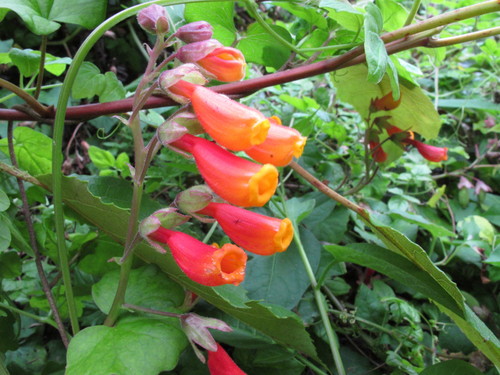
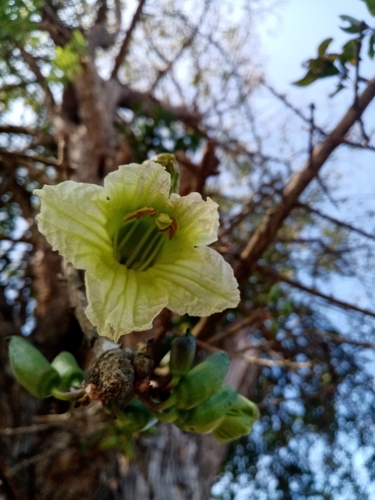
Parmentiera aculeata (Kunth) L.O.Williams is a small to medium-sized evergreen to semi-deciduous tree, usually reaching around 10 meters (33 feet) in height. Its trunk is erect, and typically measures around 30 centimeters (12 inches) in diameter. The bark is light brown to gray and slightly fissured. Young branches are cylindrical, ranging from hairless to slightly finely pubescent, with a thick thorn at each node positioned below each leaf. Leaves are arranged opposite to subopposite, and occasionally alternate; most are 3-foliate, though 4-foliate leaves occur occasionally. Petioles are 1.3–3.5 centimeters (0.51–1.38 inches) long, narrowly winged, and have a distinct deep groove on their upper surface. Leaflets have smooth margins and are elliptic to obovate in shape, with apexes that are acute or obtuse, and bases that are cuneate to attenuate. Terminal leaflets measure 1.5–6 centimeters (0.59–2.36 inches) long and 0.6–3 centimeters (0.24–1.18 inches) wide, while lateral leaflets measure 1.5–5 centimeters (0.59–1.97 inches) long and 0.6–2.5 centimeters (0.24–0.98 inches) wide. Petiolules can grow up to 1 centimeter (0.39 inches) in length. Inflorescences are few-flowered fascicles or single flowers, borne terminally or axillary near branch tips, and sometimes grow from nodes on older branches. Flowers are tubular, usually with 5 sepals, 4 or 5 petals, and 5 anthers, and may be green, white, or purple. In bud, they are acute to shortly acuminate, and measure 2.5–4 centimeters (0.98–1.57 inches) long. The calyx is spathaceous. The corolla is bell-shaped, 5–7 centimeters (2.0–2.8 inches) long and 2–2.5 centimeters (0.79–0.98 inches) wide. Stamens are slightly protruding from the corolla. Anther thecae are weakly divergent, thick, and 5–6 millimeters (0.20–0.24 inches) long. The ovary is oblong to linear, covered in small scales, and ovules are arranged in multiple rows. The fruit is a large, fleshy, fibrous yellow-green berry that grows directly from the tree's trunk and branches. It is somewhat cylindrical, thickly ribbed, tapered, and slightly curved, measuring 8–18 centimeters (3.1–7.1 inches) long and 3–5 centimeters (1.2–2.0 inches) in diameter. It contains numerous flat, somewhat round seeds around 3 millimeters (0.12 inches) in diameter. P. aculeata seeds usually germinate 1–5 weeks after planting, and trees begin flowering when they are 3–5 years old. This species is native from central Mexico south to Nicaragua. It has been introduced to southern Central America, northern South America, and the Caribbean, and is cultivated in the United States, East Africa, Maritime Southeast Asia, and Australia. It has become an invasive species in northern Queensland. It most often grows in dry to moist thickets and lowland forests, frequently near waterbodies, typically at elevations around 1,200 meters (3,900 feet). It prefers well-drained, sunny sites with medium to high rainfall, is hardy to USDA zones 10–12, and cannot tolerate frost. Throughout its native range, P. aculeata is planted as an ornamental, shade tree, and live fence. Its fruits are edible and eaten raw or cooked, and are sometimes pickled or made into preserves; their flavor is reported to be similar to sugarcane. Fruits are also used as cattle fodder in southern Mexico. The plant is widely used in traditional medicine: the fruit is used to treat common colds, diabetes, asthma, headaches, diarrhea, and gallstones, while the roots are used as a diuretic.