About Parmelina pastillifera (Harm.) Hale
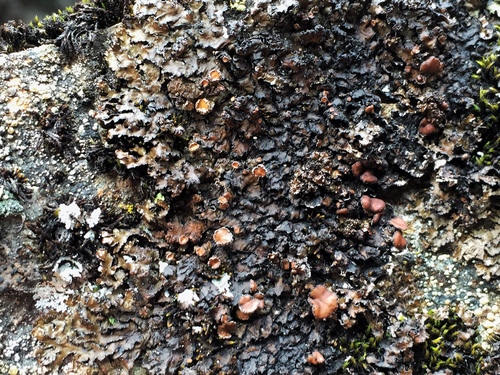
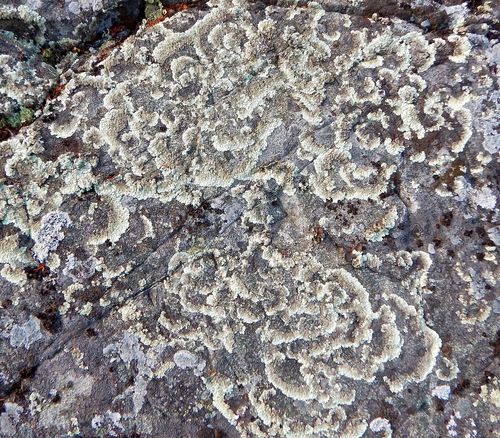
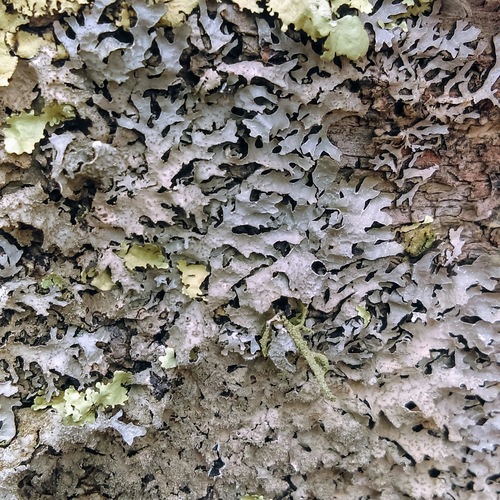
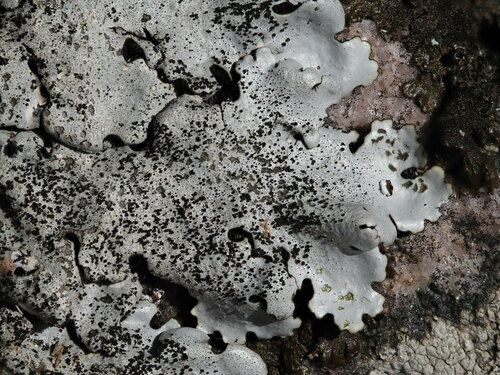
Parmelina pastillifera forms a closely attached, rosette-shaped thallus that typically measures 4–8 cm across, and occasionally grows up to around 15 cm. Its lobes are relatively narrow, about 3–7 mm wide, more or less linear, and lie close together or slightly overlap. Lobes often have a gently wavy appearance near the center of the thallus. Lobe margins are broadly rounded but irregularly indented, with short, hair-like cilia growing in the angles between adjacent lobes. The upper surface of the thallus is mineral grey with a bluish tint, faintly spotted, and often coated with pale pruina towards the tips of the lobes. The underside is black, fading to brown near the lobe edges, and bears unbranched rhizines that extend all the way out to the margins. The thallus of this species is characteristically isidiate. The isidia are blue-black, grow on the surface of the lobes, and may be scattered across the lobes or form a dense covering in the center of the thallus. They start as short, flat-topped outgrowths, but their tips quickly develop a raised rim that gives them a button-like appearance; over time they can become knobbly, twisted, and sometimes merge together. When apothecia are present, they are reported to resemble the apothecia of Parmelina carporrhizans. In standard chemical spot tests, the cortex gives a K+ (yellow) reaction, while the medulla reacts C+ (carmine-red) and KC+ (red). The medulla gives a negative reaction to K, Pd, and UV light. These results confirm the presence of atranorin and lecanoric acid in the species. Parmelina pastillifera is found in Europe, including Great Britain. It grows on well-lit, nutrient-rich or nutrient-enriched bark, especially on the branches of Fraxinus and Acer. It also grows on siliceous rocks, roof tiles, and memorials in similarly exposed, well-lit locations.