About Parmelia submontana Hale
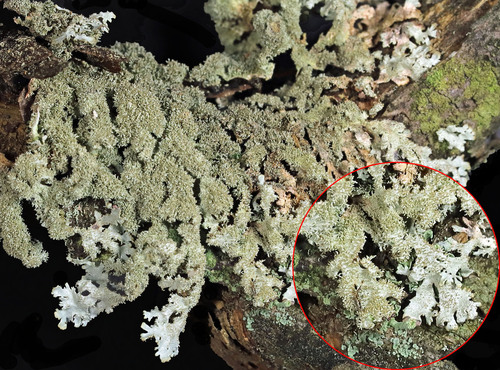
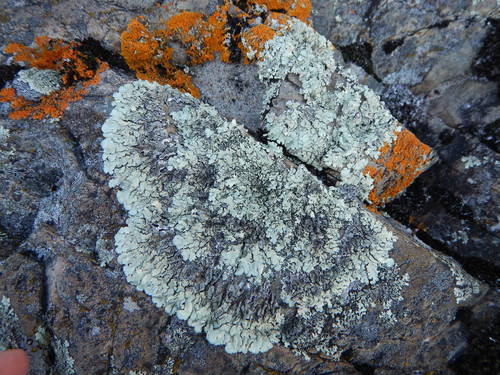
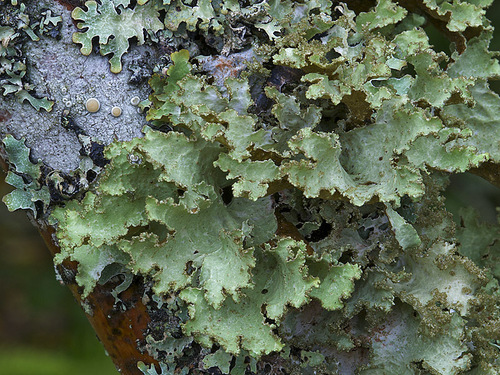
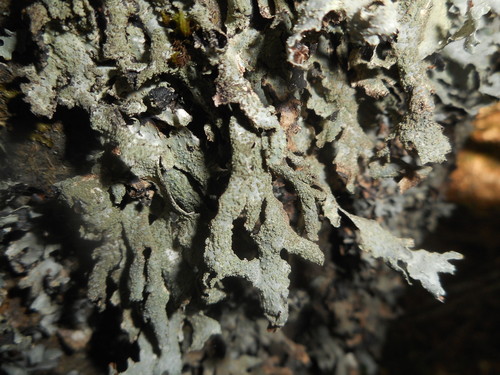
Parmelia submontana Hale is a foliose lichen whose thallus is loosely attached to tree bark. Well-developed specimens often grow trailing outward, rather than forming a tight rosette. The thallus is firm, greenish mineral-grey, and can reach 10–15 cm (4–6 in) wide. Its lobes are elongated and linear, reaching up to 30 mm long and 2–5 mm wide, with only slight branching and sometimes shallow internal channels. The upper surface is shiny, continuous, and ranges from smooth to slightly wrinkled. It bears small, round to irregularly shaped pseudocyphellae—tiny surface openings—found both on the thallus lamina (the main leafy body) and along lobe margins. These pseudocyphellae, which measure 0.3–1 mm long, quickly develop soralia: powdery patches for asexual reproduction. Soralia start out orbicular to linear, and often become eroded as they age. The soredia, tiny grain-like vegetative reproductive clusters, are granular, and sometimes look very similar to isidia (small upright thallus outgrowths). The lower surface of the thallus is black, and is sparsely covered with 1–1.5 mm long rhizines, which are root-like attachment structures. The rhizines are simple to sparsely branched; secondary branches grow obliquely off the main axis, which distinguishes them from the squarrose rhizines of some other Parmelia species, where secondary branches grow perpendicularly. Sexual reproductive structures called apothecia are rare in this species. When apothecia do occur, they are round and 1–2 mm in diameter, with a disc shape, a slightly crenulate margin, and a reddish-brown disc. The spores are colourless, single-celled, and measure 10–11 by 14–15 μm, with 2 μm thick walls. The hymenium, which measures 55–70 μm, and the excipulum are colourless, and asci are 25–55 μm long. This species occurs in two distinct morphological forms. The juvenile form, called var. minor, is characterised by small, white, punctiform (point-like) soralia on the lowest lobes; it does not grow in a rosette pattern, and lacks elongated band-like lobes. The mature form, var. perlonga, develops the species' characteristic elongated lobes, and is typically greyer in colour; it sometimes appears dusky olive because it produces numerous ovoid isidia alongside soralia. Parmelia submontana produces several secondary lichen metabolites, including atranorin, salazinic acid, and consalazinic acid. Chromatographic analysis shows that this species has an identical chemical profile to P. saxatilis, making the two species chemically indistinguishable. In addition to these major compounds, the species also contains norstictic acid and lobaric acid. When tested with potassium hydroxide solution (K test), the thallus turns yellow due to atranorin, while the medulla turns yellow then blood-red due to salazinic acid. Soralia produce an orange-red reaction in the paraphenylenediamine (P) test. Parmelia submontana is widely distributed across Europe, occurring in at least 30 countries and territories. It has been recorded across most of Central Europe, including Austria, Belgium, Switzerland, Czech Republic, Germany, and Luxembourg. In Western Europe, it is present in France, the Netherlands, and the United Kingdom. In Scotland, where it was first recorded in 2002, it often grows on introduced non-native tree species, and may be an accidental garden import. The species' range extends into Northern Europe, with populations documented in Denmark, Norway, and Sweden. In Eastern Europe, it has been recorded in Estonia, Latvia, Lithuania, Poland, Russia, Slovakia, and Ukraine. It is also present across Southern Europe, occurring in Italy, Slovenia, Greece, and Spain. Additional populations are known from several Balkan countries including Bulgaria, and the species' range extends to Turkey at its southeastern limit. Though it was previously reported from Belarus, recent comprehensive studies have not confirmed its presence there. Although it was traditionally considered a Mediterranean and south-central European species, P. submontana has been documented expanding its range northward in recent decades, particularly in Fennoscandia. In Sweden, it has been documented in the provinces of Skåne, Halland and Västergötland, while in Denmark it occurs in northern and eastern Jutland. It has also spread to Norway, where it is recorded in Aust-Agder and Vest-Agder. In northern regions, it prefers areas with high annual precipitation, typically 500–750 mm, and humid microclimates, and often occurs near water bodies such as lakes, boggy areas, or coastal regions. The species has considerable habitat flexibility: it grows in forests, gardens, parklands, forest edges, and along roadsides, though populations in open habitats usually occur near water bodies. It grows on the trunks and branches of various deciduous trees including Acer platanoides, Carpinus betulus, Fagus sylvatica, Malus domestica, Quercus robur, and Tilia cordata, and occasionally grows on conifers such as Picea abies. In the Mediterranean region, it is found more frequently on conifers, including species such as Abies cephalonica, A. pinsapo, and Pinus pallesiana. In regions like the Black Forest, the species reaches optimal development at altitudes around 800 metres. It typically occurs in association with other lichens such as Parmelia saxatilis, P. sulcata, and Pertusaria amara. In Mediterranean regions, it can be found in communities with Lobaria pulmonaria, L. amplissima, Nephroma lusitanicum, and other species that require high air humidity. This frequent co-occurrence with moisture-loving species reinforces the species' preference for damp environments. While some lichen species have declined due to air pollution and loss of suitable trees, particularly long-established avenue trees, P. submontana has shown considerable expansion in some regions. For example, in the Northern Black Forest, documented locations increased from just 5 sites in 1968 to over 70 by 1996, which suggests the species may be benefiting from changing environmental conditions or improved air quality.