About Parmelia squarrosa Hale
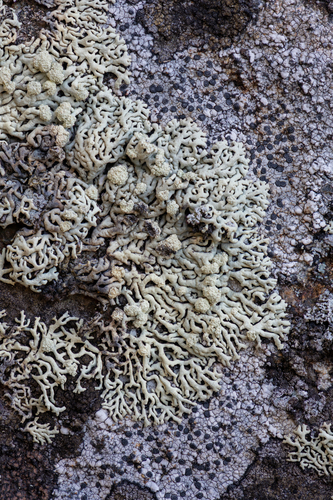
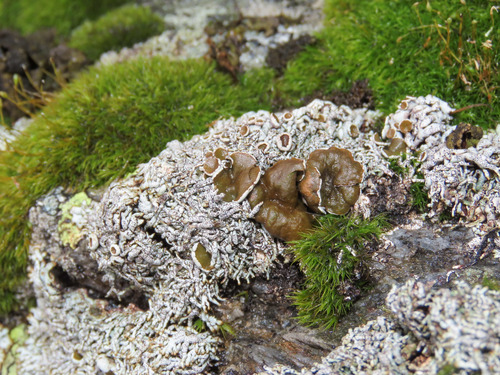
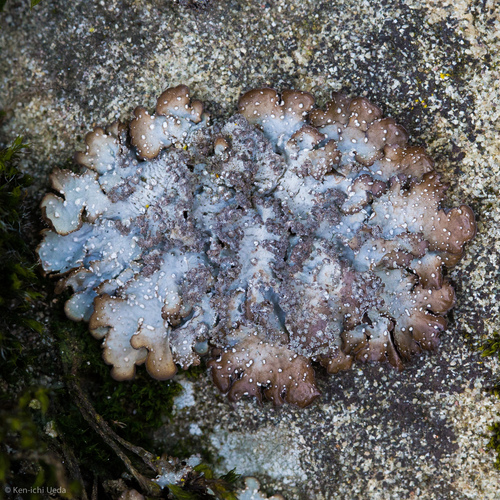
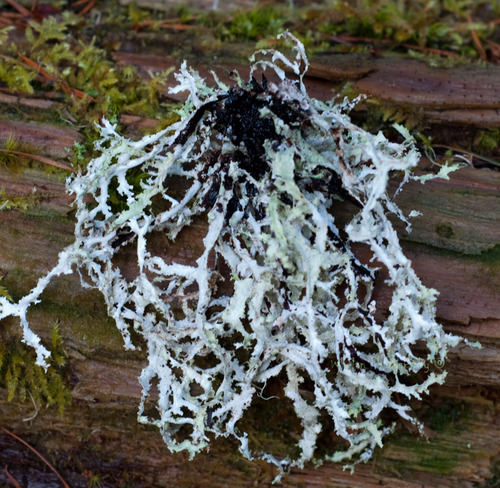
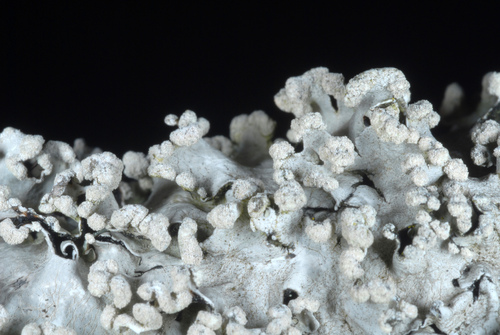
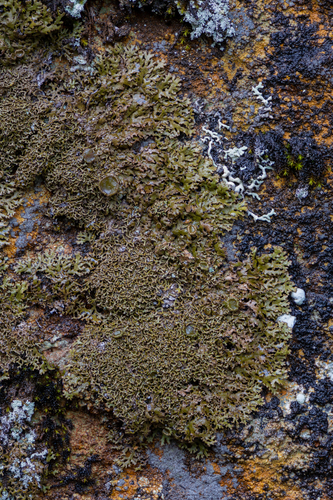
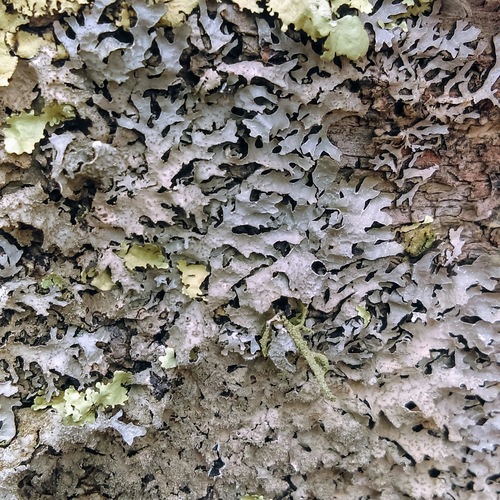
Parmelia squarrosa Hale is a lichen species whose thallus grows adnate to loosely adnate, most often on trees, less commonly on rocks, and rarely on moss. Its color ranges from greenish to whitish mineral grey, with lobes that are divaricate, contiguous, or imbricate, and measure 1–5 mm wide. The upper surface is flat to foveolate (pitted), with laminal and marginal pseudocyphellae that often form a reticulate network. Its isidia are cylindrical, grow up to 0.5 mm tall, and become dense in the older, central part of the thallus. Rhizines are squarrosely branched, and simple at the lobe margins. Both pycnidia and apothecia are uncommon for this species; ascospores measure 13–15 by 8–9 μm. This lichen produces the secondary compounds atranorin, salazinic acid, and consalazinic acid. Results of standard chemical spot tests are: cortex K+ (yellow); medulla K+ (yellow changing to red), C−, PD+ (orange). Parmelia squarrosa is widely distributed in North America, primarily in the eastern region including the Great Lakes-Appalachian area, and also occurs in western North America. Compared to Parmelia saxatilis, it occupies a more temperate and southern range, extending south to Arkansas, Alabama, and South Carolina. Its range overlaps with P. saxatilis in areas from the Great Lakes through New York and New England to Quebec and Newfoundland. Unlike P. saxatilis and P. sulcata, which are restricted to high mountain habitats, P. squarrosa has a wider distribution in the southern Appalachians that extends to the lower foothills. In 1985, Parmelia squarrosa was recorded for the first time in the western Austrian Alps and southern Switzerland, where it grows on rock. It is also widespread in eastern Asia, with confirmed occurrence reported in Japan, China, North Korea, South Korea, the Russian Far East, and Nepal. The lichen grows best in humid forests, particularly those near coastal areas, and has been observed growing on a variety of both coniferous and deciduous tree species.