About Paris quadrifolia L.
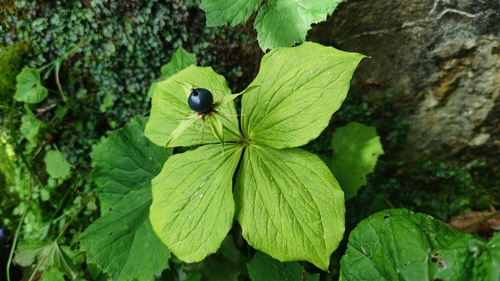
Paris quadrifolia L. is a perennial herbaceous plant that reaches heights of 25 to 40 cm (10 to 15.5 in). It can have between 3 and 8 leaves, but typically bears four leaves arranged as opposing pairs. The flowers are wispy, inconspicuous, and bloom from June through July. The plant produces a single solitary flower that sits above a single whorl of four leaves. This flower has four narrow greenish threadlike (filiform) petals, four green petaloid sepals, eight golden yellow stamens, and a round purple to red ovary. Each individual plant produces at most one blueberry-like berry, which persists for an average of 46.2 days. Each fruit contains an average of 33.6 seeds. Fruits of this species average 89.6% water; their dry weight is composed of 14.5% carbohydrates and 2.6% lipids. The berry, along with all other tissues of the plant, is poisonous due to containing solanine. Poisonings from this plant are rare, because its solitary berry has a repulsive taste that means it is not often mistaken for a bilberry. Raphides are present in at least the perianth, stem, and smaller cells of the rhizome, and occur in abundance in the root. The raphis-cells of this plant are elongated, pointed at the ends, and are much longer than the raphides they contain. In patches studied by Ehrlén and Eriksson in 1993, the small granivorous rodents Clethrionomys glareolus and Apodemus sp. removed up to 80% of the species' fruits. These rodents consume most of the seeds, but only eat a small proportion of the fruit pulp. Since some seeds normally escape predation, these rodents also act as seed dispersers for the plant.