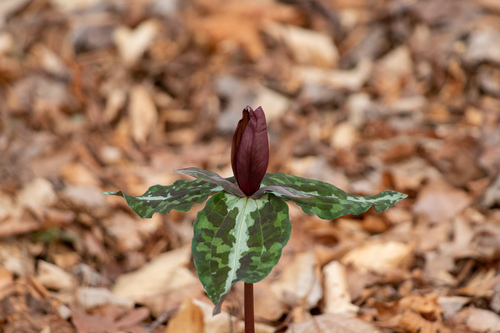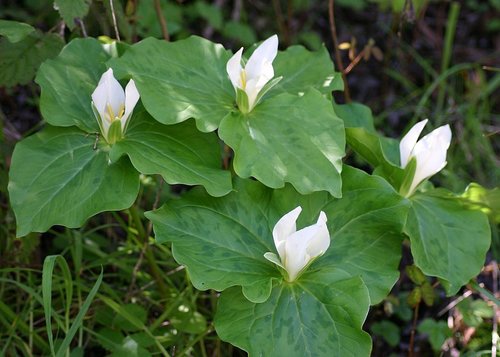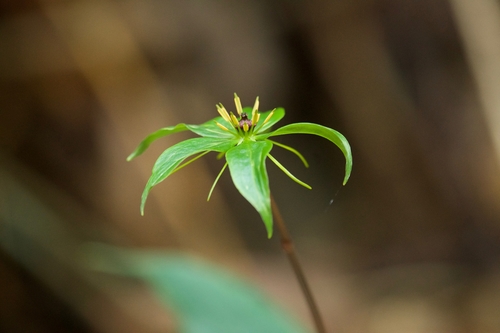
About Paris polyphylla Sm.
Paris polyphylla Sm. usually grows 10–100 cm tall from a rhizome 1–2.5 cm thick. Its leaves grow in a whorl at the top of the stem, and can be sessile or petiolate, with shapes ranging from lanceolate to ovate or elliptic. The species is extremely polymorphic, with a range of variant forms that have documented characteristic differences. Its ovary is superior and holds numerous ovules. The fruit is either a berry or a berry-like capsule; when ripe, its seeds are enclosed in a red, succulent aril. This species prefers to grow in forests, bamboo forests, thickets, grassy or rocky slopes, and stream sides. It favors moist, damp, shady locations such as the ground under deciduous trees. It can grow at altitudes up to 3300 meters, and grows best in moist, humus-rich soil under forest canopy, in conditions ranging from full to partial shade. Higher levels of soil nutrients including organic matter, nitrogen, and phosphorus were found in areas where this plant does not grow, while higher phosphorus levels are typically found in areas where it does grow. Among different varieties of P. polyphylla, stamen counts match the number of outer tepals (most commonly eight) or are higher. Stamens have short filaments, which are about 10 mm long, while anthers measure around 12 mm. The ovary is subglobose, ribbed, one-loculed, and sometimes tuberculate. The style is short, has an enlarged base, and ranges in color from purple to white. The dry capsule is globose and sometimes tuberculate. In natural field conditions, this plant reproduces mainly through vegetative propagation. After sowing, P. polyphylla seeds produce a primary root about seven months later, then grow leaves approximately four months after that, in the second year. Seeds of this plant can enter dormancy; this dormancy is thought to be caused by changes in several endohormones, development of inhibiting substances, and increased material accumulation during the embryo's physiological ripening period. Only one offspring grows from a single mother plant, which has led to rapid declines in this species' population numbers. Paris polyphylla Sm., known locally as Satuwa, is listed as vulnerable by the IUCN. This species has low seed viability, and its seeds do not germinate in laboratory conditions even when treated with different chemicals. Conservation efforts need to include raising awareness among people living in areas where P. polyphylla grows, and communicating information about sustainable rhizome use and cultivation practices to support the species' conservation. If a portion of the rhizome containing the bud is left underground after harvest, the plant can regrow, supporting more sustainable harvest and helping conserve wild populations into the future. A study conducted in Nepal identified overharvesting, unscientific rhizome collection, harvesting before seeds reach maturity, low viable seed production, and long seed dormancy as the major threats to the species' propagation. P. polyphylla is a traded medicinal plant, and populations have become less abundant over the past decade, a change that may be linked to deforestation. In the traditional folk medicine of Nepal, local communities have used this species since ancient times. It is primarily used to treat fevers, headaches, burns, and wounds, and to treat a wide range of livestock diseases, mainly to neutralize poisons. Local people harvest the rhizome during the fruiting season in October, just before the plant dies back, when the plant is easiest to find and harvest. However, the Gurung people in particular believe plants harvested on the Tuesday mid-April corresponding to the last Tuesday of the Chaitra month have stronger medicinal effectiveness than those harvested at other times. In the past, P. polyphylla rhizomes were collected and traded on a large scale, and shipped to the Nepali cities of Pokhara and Kathmandu. Currently, no commercial trade of P. polyphylla takes place, because commercial collection is banned within the Annapurna Conservation Area.