About Parides sesostris (Cramer, 1779)
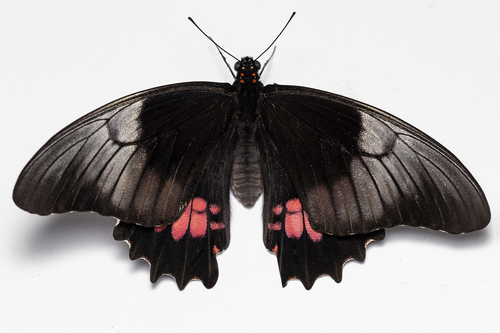
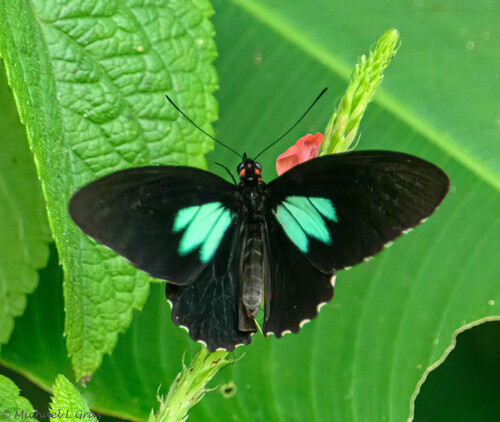
Parides sesostris (Cramer, 1779) has a wingspan of 100–110 millimetres (3.9–4.3 in). Its head, thorax, and abdomen are all black. On the upperside of its forewings, the base color is black, with large green areas covering the basal portion. The underside of the forewings is dark brown. The underside of the hindwings is dark brown, with a chain of red spots along the outer edge. The hindwings have a scalloped edge but lack tails. The larvae of this species feed on Aristolochia barbata, A. bicolor, A. grandiflora, A. sprucei, and A. trianae. This species is not threatened. The description from Seitz notes the following: For P. sesostris, male forewings have a very large green area that touches the cell. The hindwing is either black, or has a red spot before the hindmargin. Female forewings have at least two white spots, and the red band on the hindwing is generally broad. The male scent-organ has white wool, except at the base, which is black. This species ranges from Mexico to the Amazon, and is divided into three subspecies. The northern subspecies is zestos Gray. Males of this subspecies always have a red spot on the hindwing. In females, the band on the upper surface of the hindwing is bright red. This subspecies occurs from South Mexico to Costa Rica. Subspecies tarquinius Boisd. is found from Panama to Ecuador and North Venezuela. Males usually have a red spot on the upper surface of the hindwing similar to zestos, but the band on the underside is positioned more obliquely. In females, the second white spot on the forewing is somewhat larger than in zestos, and the band on the underside of the hindwing is closer to the cell. Nominate subspecies sesostris Cr. (female = tullus Cr.) very rarely has a red spot on the upper surface of the male hindwing, and the spots on the underside are positioned somewhat closer to the margin. In females, the two white spots on the forewing are widely separated from the cell. This subspecies ranges across Orinoco, Guiana, Para to Peru, Bolivia, and Goyaz. This species is a strong flier that reportedly never leaves wooded areas. A full formal description of this species was published by Rothschild, W. and Jordan, K. (1906). Parides sesostris is native to the Americas, and is widespread from Mexico to Brazil and Peru.