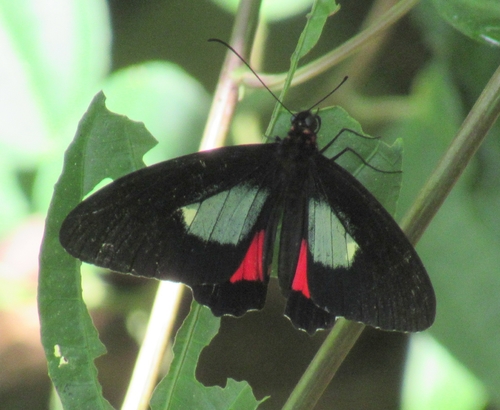
About Parides panares (Gray, 1853)
Scientific name: Parides panares (Gray, 1853).
Description sourced from Seitz, noting that Seitz misidentified panares panares as iphidamas, referencing P. lycimenes. Males are somewhat smaller than P. vertumnus. The red area on the male hindwing is less triangular, and its last spot is smaller. Females have slightly transparent forewing apices; their forewing spots are somewhat yellowish rather than pure white, and the cell-spot is usually large, extending across the cell. The hindwing band is less bright red than in P. vertumnus. The male tibiae are not thickened. The species ranges from Guatemala to Ecuador, and is divided into several subspecies.
lycimenes Boisd. is the Central American subspecies. Its forewing bears a large green spot that almost always encloses at least one white spot, and often has an additional spot within the cell. The hindwing has 4 to 6 red spots. In female lycimenes, the yellowish white spot before the 1st median vein is much larger than the preceding spot. The hindwing band is broad, and almost always uniform bright red. This subspecies occurs from Guatemala to Panama, and is also found on small islands off the west coast of the Republic of Panama. erythrus R. & J. Males have a broader green spot than the lycimenes subspecies, with the spot reaching the wing's hindmargin. Females have a larger spot before the 1st median vein of the forewing than lycimenes females, and a paler hindwing band. This subspecies is found in Central and East Colombia and North Venezuela. paralius R. & J. This is a small subspecies. Males have a round yellow-white spot before the 2nd median vein on the forewing, and a short, narrow hindwing band. Females have forewing spots that are purer white than those of the previous two subspecies, with a reduced cell-spot. The spot before the 2nd median vein is the largest spot on the forewing, and the hindwing band is almost straight. This subspecies occurs in West Ecuador.
A full description of Parides panares is provided by Rothschild, W. and Jordan, K. (1906). See the synonymy note under the Seitz description above.