About Parides neophilus (Geyer, 1837)
Scientific name: Parides neophilus (Geyer, 1837)
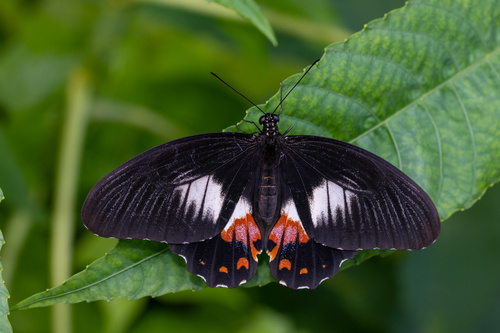
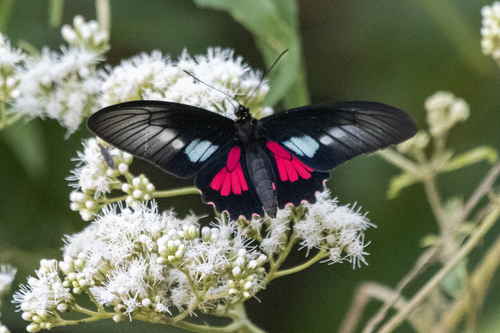
This description is reproduced from Seitz: For P. neophilus, in males, the cell of the upper surface of the hindwing is red almost all the way to the base. In both sexes, the second median vein of the hindwing arises at the same height as the subcostal vein. The species ranges from Colombia to Paraguay and southern Brazil, but is not found from Rio de Janeiro to Pernambuco, the area where P. zacynthus occurs.
eurybates Gray (= euphales Gray) (5c): Males have large white spots on the forewing. The red spots on the hindwing are not blackish toward the base, except for the first and last spots; the middle red spots touch the cell on the underside of the wing. Females have 2 white spots between the third radial and second median vein; spots are rarely only faintly indicated, and the red band on the hindwing is broad. This form occurs in Sao Paulo, Matto Grosso, and Paraguay, and is a transitional form leading to the next subspecies.
consus R.& J.: In males, the green area between the second median vein is longer than it is broad, the white spot before the second median vein is rounded, and it is usually smaller than the preceding spot. On the hindwing, the cell-spot and the portion of the discal spot adjacent to the cell are blackish red. The spots on the underside are smaller than those of eurybates. In females, the white spots are large, and the band on the hindwing is usually separate from the cell. This form is found in East Bolivia.
olivencius Bates (5 c): In both sexes, the white spots on the forewing are small or indistinct. In males, the red spots on the hindwing are long on the upper surface and short on the underside. In the female aberration anaximenes Fldr, the hindwing spots are very long. This form ranges from East Peru to the Cordillera of Bogota, and along the Amazon downstream to the Rio Negro.
ecbolius R.& J.: The green spot behind the second median vein of the forewing is about as long as it is broad. The white spot before this vein is distinct and transverse, matching the shape of the preceding spot. The red spots on the hindwing are shorter than those of olivencius. In females, the forewing has one large white spot before the second median vein and another before the first median vein; the outer margins of these spots are almost parallel to the outer margin of the wing. This form occurs on the Lower Amazon, upstream to Obidos.
neophilus Hbn. (= gargasus Hbn. [partim], aeneides Esp. [partim]): This is the first described form, and it inhabits the Guianas. In males, the green area is broader, and the red spots on the underside of the hindwing are smaller than those of male ecbolius. In females, the forewing has no white spots, or only small white spots; large spots occur rarely. The third spot on the hindwing is longer than the other spots, and the spots on the upper surface sit further from the wing margin than they do in olivencius.
parianus R.& J.: This form comes from Trinidad, Gumana and the Orinoco. In males, the green area behind the second median vein is longer than it is broad, and encloses three white spots. The spots on the underside of the hindwing are paler than those of the Bolivian consus form, which parianus is closely related to. The spot before the second median vein sits close to the cell. In females, the hindwing band is somewhat more curved than it is in other subspecies, and the narrow middle spots are positioned close to the cell on both wing surfaces.
A full description of this species is provided by Rothschild, W. and Jordan, K. (1906), as noted in their 1906 work.