About Parides iphidamas (Fabricius, 1793)
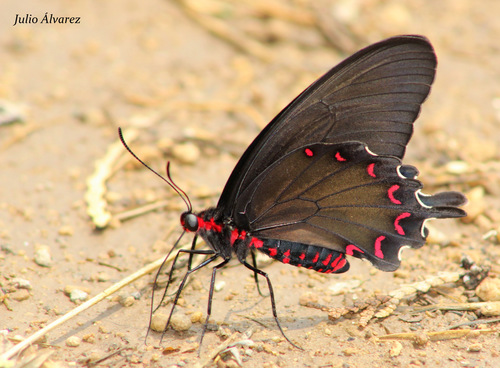
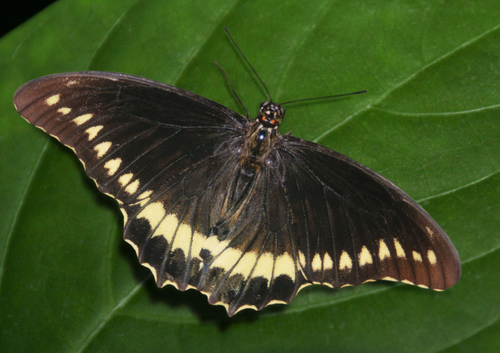
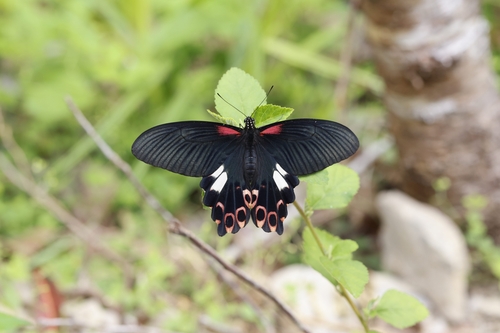
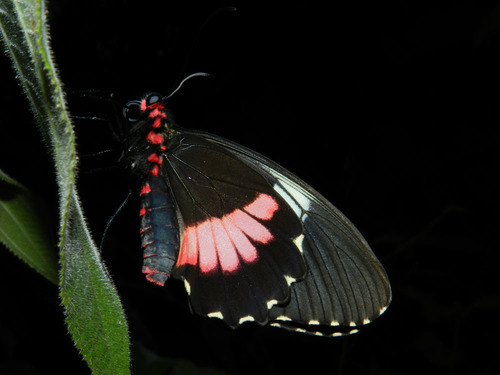
Parides iphidamas (Fabricius, 1793) is a butterfly species with a wingspan of about 10 centimetres (3.9 in). On the dorsal side of the forewings, the base color is black, marked by a broad green patch that contains white spots; these markings are completely white in females. The dorsal side of the hindwings features a broad red band or spot, and many small yellow spots run along the wing edges. The undersides of the wings are black, with a white band on the forewings and several pink patches on the hindwings. The butterfly's body is black with red dots. Its poisonous caterpillars are chocolate brown, with white or brown thorn-like protrusions. Caterpillars feed on various toxic Aristolochia species, including A. cordiflora, A. maxima, A. odoratissma, A. pilosa, A. ringens, and A. tonduzii. This description draws from work by Seitz, who notes that for male P. iphidamas, the tibiae and first segment of the tarsi are thickened and covered in fine hairs. Compared to P. erithalion, females of P. iphidamas have less deep black coloration along the forewing margin. P. iphidamas ranges from Mexico to Ecuador and northern Venezuela. It is a common species that is difficult to distinguish from P. erithalion and P. lycimenes, so it is often mistaken for these two species. Seitz also describes the accepted subspecies of P. iphidamas. The nominate subspecies iphidamas is the Central American form, found from southern Mexico to Panama. For nominate male iphidamas, the forewing is not transparent distally; the green area is usually reduced, always encloses one or two white spots, and often has an additional white spot in the cell. The hindwing band gradually widens posteriorly, with a narrow spot behind the second median. For nominate female iphidamas, the cell-spot on the forewing is large, and there are usually several small spots beyond the cell. The spot before the second median is smaller than the preceding spot, or is obliquely cut off toward the base. The hindwing band is almost unicolorous bright red, with an evenly curved inner margin. Subspecies phalias R & J. is found in Colombia's Magdalena Valley and the Cordillera of Bogota. For male phalias, the green area is widest posteriorly and reaches the hindmargin; the hindwing has three red spots separate from the cell. For female phalias, the forewing apex is slightly transparent, the cell-spot is very large, the spot before the first median is much larger than the preceding spot, and the hindwing band is very broad and paler on its inner side. Subspecies elatos R & J. is found in the Cauca Valley. For male elatos, the green area is smaller than in phalias, and the hindwing has three small red spots. Subspecies calogyna R. & J. occurs in western Ecuador and the west coast of Colombia. For male calogyna, the forewing is more thickly scaled on the exterior than phalias and elatos, and usually has a white spot before the second median; the hindwing has three small, closely spaced red spots. For female calogyna, the spot before the first median on the forewing is larger than the preceding spot, the hindwing band is bright red, and its inner margin is usually white. Subspecies teneates R.&J. is found in northern Venezuela and northern Colombia. For male teneates, the green area is narrow, separated from the cell, and usually encloses one or two white spots; females have not been identified with certainty. A full species description was published by Rothschild and Jordan in 1906. This species is native to Central and South America, occurring from southeastern Mexico through Costa Rica and Panama to Peru. It is common in a wide range of habitats, from open lowlands to wooded areas and tropical forests, at elevations from sea level up to 1,200 meters (3,900 ft). Females are primarily found where their caterpillar host plants grow, in forest clearings and along forest edges.