About Parides erithalion (Boisduval, 1836)
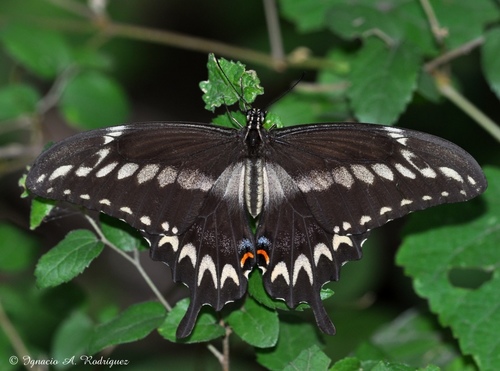
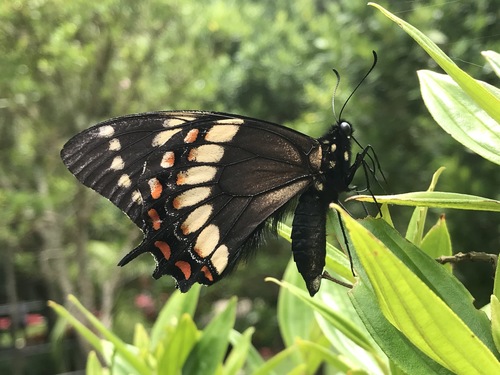
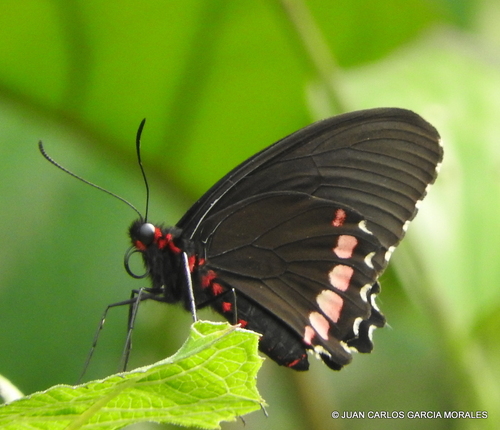
Parides erithalion (Boisduval, 1836) is a butterfly species first described by Boisduval in 1836. The upperside of its wings is black, marked with a row of red postmedian spots. The underside of the wings is also black, with a row of pink and whitish spots. In males of some subspecies, the forewing uppersides bear a large olivaceous-green patch extending forward from the inner margin, plus a creamy-white spot, while the hindwings have a band of three red spots. The wing fringe is dotted with white in both sexes. This species description is sourced from Seitz, with additional details as follows: For the nominal P. erithalion, the male does not have thickened tibiae, and the hindwing lacks a distinct red spot behind the second median vein on the upper surface; the female has a spot before the first median vein of the forewing that is smaller than the preceding spot, and the band on the hindwing is broad and pale on the inner side. This species ranges from Costa Rica to northern Venezuela. Subspecies: zeuxis Luc. (with synonyms = rhameses Doubl., rhesus Koll., rhamases Fldr., abilius Fldr., rhamses Boisd.) (4a). In male zeuxis, the green area is much narrowed anteriorly and encloses a large white spot before the 2. median; the hindwing has 2 or 3 small red spots. In female zeuxis, the posterior spot of the forewing is larger than the preceding one. This subspecies is found in North Venezuela and on the eastern side of the Cordillera of Bogota. Subspecies erithalion Boisd. (4a) from Central Colombia (Rio Magdalena). Males of this subspecies rarely have a white spot on the forewing, located before the 1. median or between the radials. Females have the spot before the 1. median smaller than the preceding spot, and generally have a few small spots outside the wing cell. Subspecies cauca Oberth. Males have the green area of the forewing completely absent or only faintly indicated. Females have a narrow, curved band on the hindwing that is separated from the cell. This subspecies occurs in the Cauca Valley. Subspecies sadyattes Druce (4a), found from Costa Rica to Panama. In males of this subspecies, the green area is very variable, generally reduced and often absent; all specimens have at least one white spot, located before or behind the 3. radial, and often have a green spot in the cell. Females have an almost unicolorous bright red band on the hindwing. A full species description was published by Walter Rothschild and Karl Jordan in 1906. In this treatment, polyzelus is recognized as a full species, and trichopus is treated as P. z. trichopus. For the life cycle: The eggs are brownish, and the caterpillar is brownish black with white and reddish-brown tubercles.