About Parides childrenae (Gray, 1832)
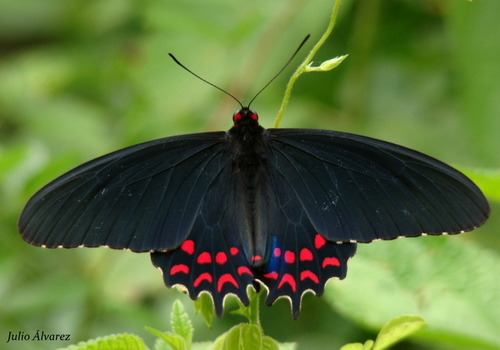
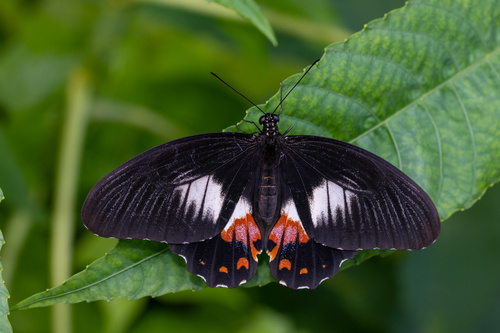
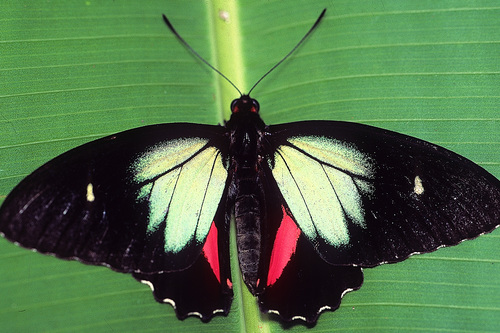
Parides childrenae (Gray, 1832) has black wing uppersides. Males have a bright green patch and a small pale yellow subapical spot on the forewing, and a red patch on the hindwing. Females have a small white patch on the trailing edge of the forewing, a few pale subapical spots, and a band of red spots across the hindwing. The wing underside is also black. On the underside, males have small pale subapical spots on the forewing and a few red spots on the hindwing, while the female underside matches the female upperside in pattern. According to Seitz's description of P. childrenae, the male's green area is larger than that of P. sesostris, and it also covers part of the cell. The female has a transverse row of spots before the apex of the forewing, as well as two spots posteriorly on the disc. The species is distributed from Guatemala to Ecuador, and is divided into two subspecies. The first subspecies, Parides childrenae childrenae (Gray, 3 a), is the Central American form found from Guatemala to Panama. Males of this subspecies have a white spot before the apex of the forewing, and females have a bright red band on the hindwing. The second subspecies is Parides childrenae oedippus Luc. Males of this subspecies have no white spot before the apex of the forewing, or only a very small one. In females of this subspecies, the inner side of the hindwing band is somewhat yellowish red. This subspecies occurs in Colombia and Ecuador. A full description of Parides childrenae is provided by Rothschild, W. and Jordan, K. (1906).