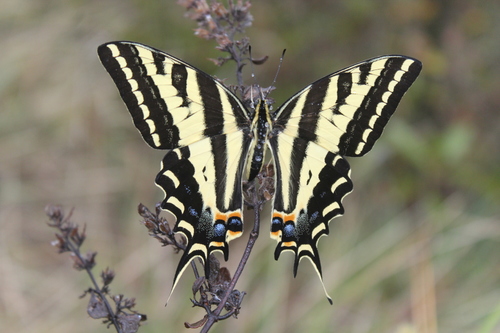
About Parides anchises (Linnaeus, 1758)
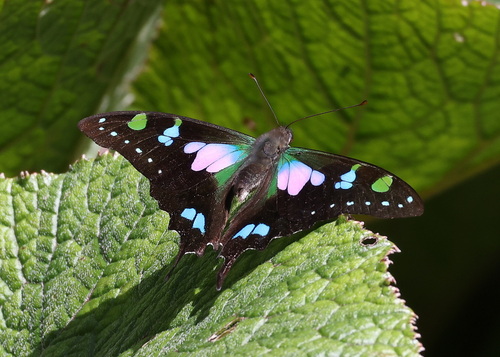
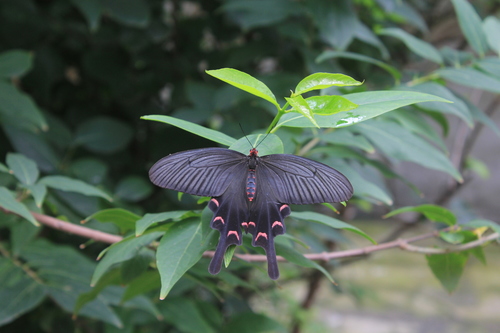
This species is Parides anchises (Linnaeus, 1758), with the original description taken from Seitz. For the main species, the apex of the forewing is distinctly, though only slightly, transparent. In males, the tibiae and first segment of the tarsi are thickened and covered with fine hairs; the hindwing is blue and strongly iridescent. In females, the spot before the first median is larger than the preceding spot. The species ranges from Colombia to southern Brazil and Paraguay. The black-brown larva has two dorsal spots on the first and penultimate segments, and one lateral spot on each of the thoracic segments and the 8th and 9th abdominal segments. An oblique lateral band, sometimes broken into spots, is present on the 6th and 7th segments. The dorsal humps on the pupa are three-edged and rather small.
alyattes Fldr. (4b, c): In males, the green area is separate from the cell, enclosing at least one white spot placed before the second median. Many specimens have a second spot before the first median, and the last spot on the inner surface of the hindwing is larger than in P. iphidamas phalias. In females, the cell-spot is narrow; the band of the hindwing enters the end of the cell, and the black outer margin is wider than in P. iphidamas. This subspecies is found in Colombia, in the Magdalena Valley, and probably on both sides of the Cordillera of Bogota.
serapis Boisd.: In males, the green area is very long and narrow, only slightly wider posteriorly than anteriorly; the band of the hindwing consists of at least five spots. In females, the cell-spot is large, almost triangular, the spot before the first median is very large, and the band on the hindwing is very broad. This subspecies occurs in northern Colombia. The distribution of both serapis and alyattes is only very imperfectly known.
osyris Fldr. (= xenares Fldr., toxaris Fldr., severus Fldr.) (4 b): In males, the green area of the forewing and the band of the hindwing are broader than in serapis. In females, the cell-spot usually extends transversely across the cell; the band of the hindwing is very little paler internally than externally. This subspecies is found in Venezuela.
cymochles Doubl. (= anacharsis Fldr.): In males, the forewing has one to three spots; the hindwing has three, occasionally four, red spots. In females, the spots of the forewing are purer white than in the preceding subspecies; the cell-spot is small; the band of the hindwing is almost unicolorous red, and broadest in the middle. This subspecies occurs in Trinidad, Paria Peninsula and Orinoco.
anchises L. (= telmosis Bates, toxaris Fldr.) (4 c): In males, the green area is narrow, sometimes absent; the hindwing is more strongly dentate than in the other forms, and the red spots are usually widely separated. In females, the forewing has no cell-spot or only a cell-streak, and often has no spots at all; the hindwing has a row of six or seven red spots, separated from one another. This subspecies is found in Dutch and French Guiana.
thelios Gray (= hierocles Gray, aglaope Gray [partim.]) (5 a): In males, the green area is triangular, enclosing one or two rather large white spots; the hindwing has three or four red spots, of which the one before the second median is the largest. In females, the forewing has at least two white spots, and the one before the second median is the largest; the hindwing has seven or eight separated spots. This subspecies occurs in the lower Amazon, from Para to Santarem; it is found in dry, sandy places in the forest, not in swamps.
etias R.& J.: In males, the palpi sometimes have almost no red scales; the hindwing has no red spot before the first radial, or this spot is very small. In females, the spots on the forewing are pure white, the cell-spot is very small, and two large white spots are present before and behind the first median. This subspecies is found in eastern Bolivia, collected by J. Steinbach in December, January, and April–May.
orbignyanus Luc. (4 c): On the male hindwing, the red band is uniformly curved and gradually becomes narrower anteriorly; the forewing has at least one large white spot. In the female, there is a spot in the cell of the forewing and at least two on the disc; the hindwing has a band running from the subcostal to the hindmargin. This subspecies is found in Paraguay; the northern part of Entre Rios; Matto Grosso; Goyaz.
foetterlei R. & J. (4 c): In both sexes, the white spots on the forewing are very large, and the band on the hindwing is very broad. This subspecies occurs in the interior of the province of Sao Paulo.
A full description of Parides anchises is provided by Rothschild, W. and Jordan, K. (1906).