About Pareronia hippia
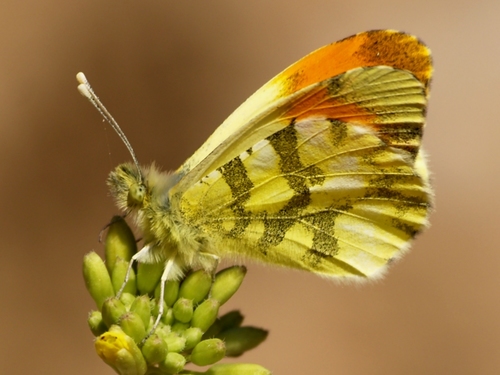
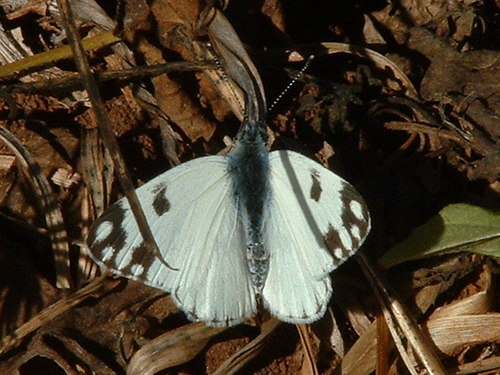
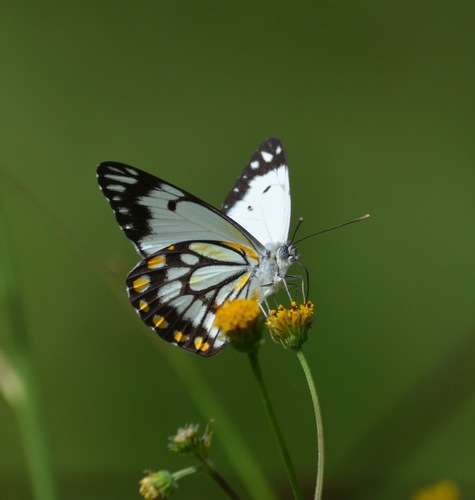
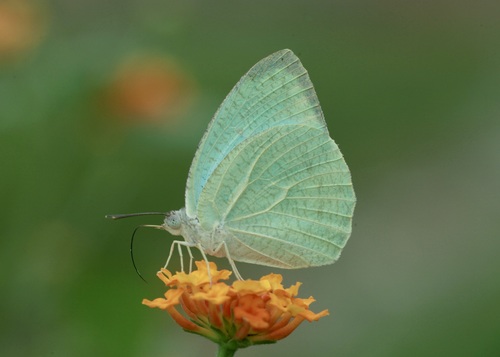
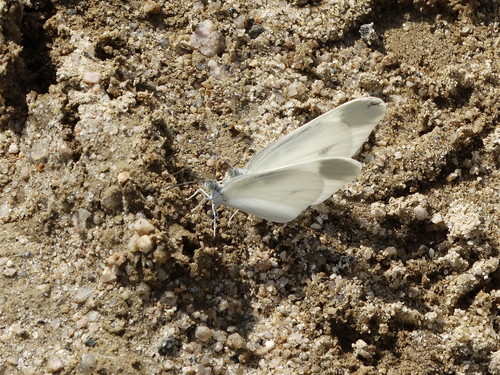
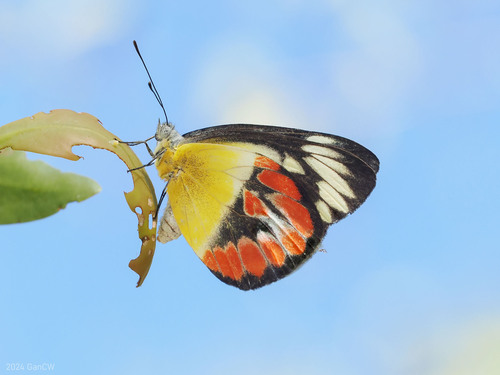
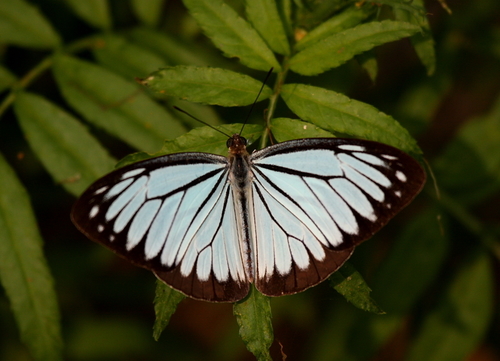
Pareronia hippia can be described as follows based on sex and form. For males: The upperside has a clear pale blue ground colour, which is a much deeper tint than that of Pareronia avatar (Moore). All veins are outlined in black. On the forewing, the costa is broadly black, while the apex and terminal margin are very broadly black. This black colour on the termen narrows towards the tornus, and is crossed by a transverse subterminal series of bluish-white spots that vary in number. The spot in interspace 3 is shifted inwards, and sometimes the posterior two spots of the series are almost joined to the ground colour streaks between the veins. On the hindwing, the dorsal and costal margins are broadly whitish, and the terminal margin is broadly black, especially at the apex. Except at the tornus, the black area is covered with specialised opaque-looking scales. The underside is a paler blue, with obscure fuscous terminal margins on the wings, crossed by a very indistinct transverse subterminal series of whitish lunulated spots. On the forewing, the veins are more or less broadly bordered with black, and this edging broadens towards the termen. The apex is broadly suffused with a somewhat obscure pearly-white lustre, which decreases along the terminal margin towards the tornus. On the hindwing, the subcostal vein and veins 6, 7, and 8 are broadly edged with black, while the remaining veins are very narrowly edged with black, and there is a very fine black line in interspace 1. The cilia of both the forewings and hindwings are very narrow and white. Antennae are black; the head, thorax and abdomen are fuscous, and the thorax is covered with long bluish hairs. On the underside, the palpi, thorax and abdomen are pale silvery bluish white. For the common female form: The upperside is black, and all markings are bluish white. On the forewing, the cell has two streaks: the anterior streak extends from the extreme base, and the posterior streak starts from the end of the basal third but extends beyond the anterior streak. Below and beyond the cell there is a series of streaks in the interspaces. These streaks are very irregular in length: the streak in interspace 1 is the longest, angled anteriorly and divided longitudinally from near its base; the streak in interspace 3 is short and broad, forming an elongate spot; and the streaks in the anterior interspaces are more or less obliquely placed. Beyond these streaks runs a subterminal transverse series of spots, in which the spot in interspace 3 is shifted inwards, and the spots opposite the apex curve backwards. On the hindwing, the costa and dorsum are broadly white. The cell and interspaces beyond have a series of streaks and subterminal spots, generally matching the pattern on the forewing but more regular. The streak in the cell and interspace 1 is divided longitudinally, and the subterminal series of spots is evenly curved. The underside is similar to the upperside, but the ground colour is dull, dusky and diffuse; the markings are broader but less clearly defined, and the apical area on the forewing is obscured by a powdering of whitish scales. The antennae, head, thorax and abdomen are much the same as in the male but darker. The philomela form of female is very similar to the common form, with matching markings on both the upper and undersides. The difference is that on the upperside of the hindwing, the base of interspace 1a, the entire interspace 1, the area of the cell, and the base of interspace 2 are suffused with bright yellow. On the underside, these same areas are dull ochraceous. The extent of the bright yellow colour on the upperside and the dull ochraceous tint on the underside varies between specimens: in some it is more restricted, while in others it spreads further towards the costa. The common form of female mimics the glassy tiger to avoid predation. The philomela form is rare, identified by the yellow colouration at the base of the wings, and it is reported more frequently in north-east India. According to Mark Alexander Wynter-Blyth, this form mimics Danais aspasia, a species that is not found west of Myanmar. Wynter-Blyth rejects the assumption that the wagtail carries eggs of D. aspasia to India, and suggests that D. aspasia may have once occurred in India alongside the common wanderer in bygone eras, before being eliminated from the region.