About Pareques acuminatus (Bloch & Schneider, 1801)
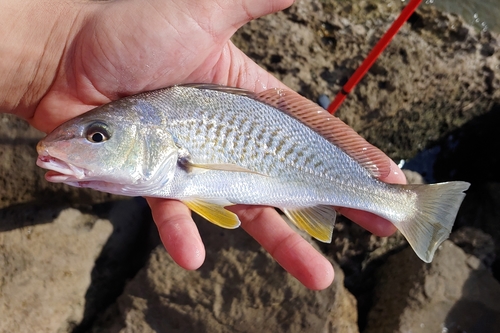
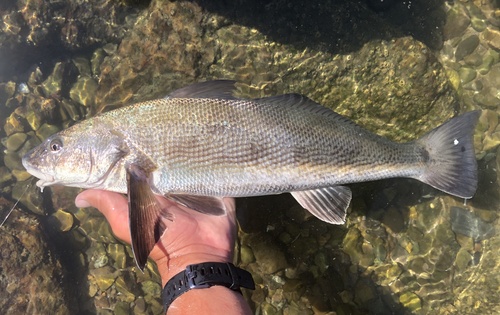
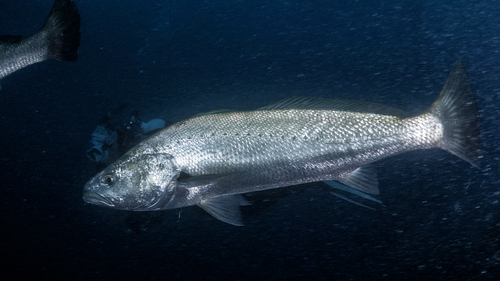
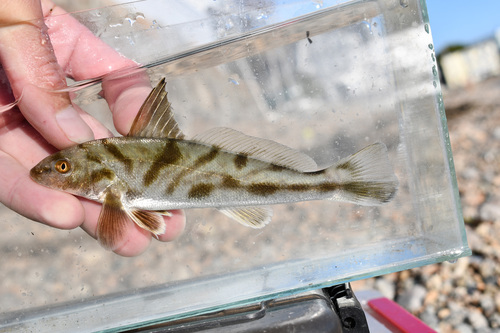
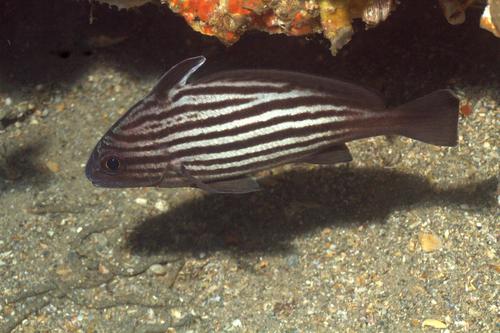
Pareques acuminatus has a deep, rhomboid-shaped body with an arched dorsal profile. Its head is low, and the snout protrudes past the mouth; the upper jaw is notched and encloses the lower jaw. Villiform teeth grow in bands, with the teeth in the outer row of the lower jaw being enlarged. There are no barbels on the chin, but the chin has five pores, while the snout has ten pores. The preoperculum has weak serrations. The long-based dorsal fin has a deep notch that separates its spiny and soft-rayed sections. Between eight and ten spines sit before the notch, with one spine and 37 to 41 soft rays behind the notch. The spiny section of the dorsal fin is tall, and the sixth spine is the longest. The anal fin is supported by two spines, the second of which is quite thin, plus seven or eight soft rays. Body scales are ctenoid, while head scales are cycloid; the bases of the soft-rayed sections of the dorsal and anal fins are thickly covered in scales. This fish species has black and white longitudinal stripes. The maximum published total length for this species is 23 centimetres (9.1 inches), though 18 centimetres (7.1 inches) is a more typical length. In terms of distribution and habitat, Pareques acuminatus occurs in the western Atlantic Ocean, ranging from North Carolina south through the Caribbean and Gulf of Mexico to Venezuela. It lives at depths between 60 and 70 metres (200 and 230 feet) in clear waters around tropical islands, where it is often associated with coral reefs. It is also found in nearby bays with rubble substrate or the eroded borders of seagrass beds.