About Pardosa pseudoannulata (Bösenberg & Strand, 1906)
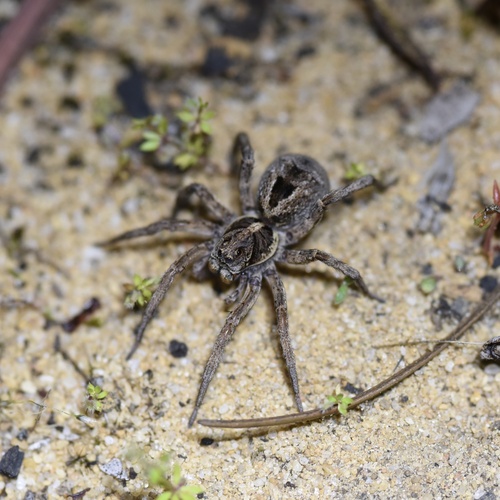
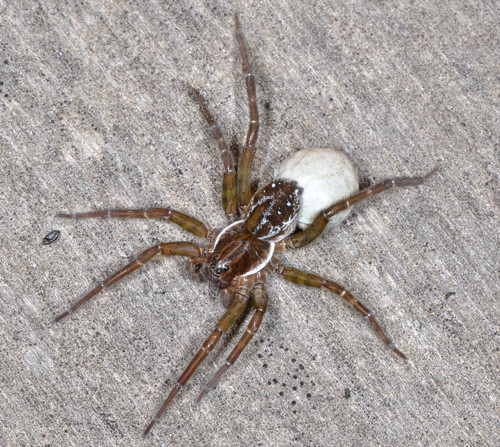
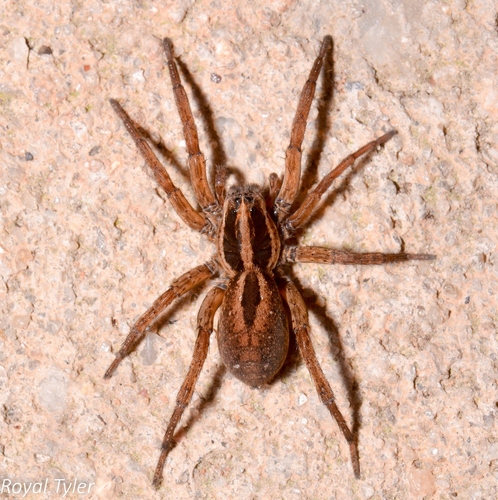
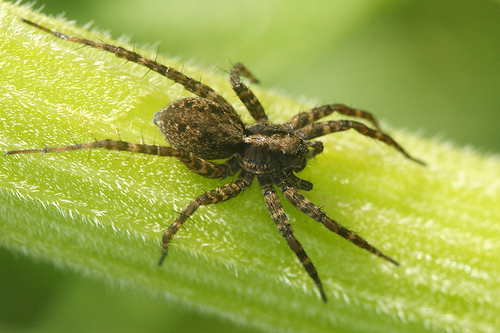
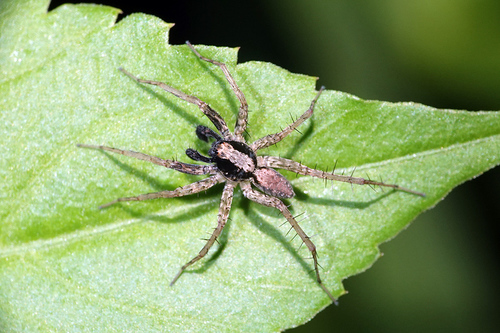
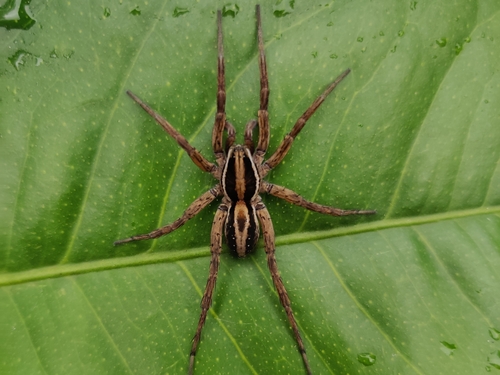
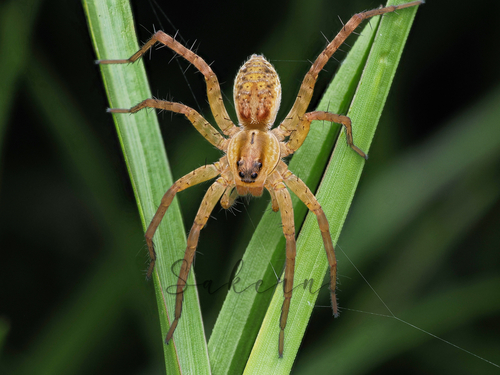
Pardosa pseudoannulata shows strong sexual size dimorphism, with females an average of 1.3 times larger than males. This species can be identified by ring markings on its legs, dark bands on its carapace, and six black dots on its underside. Most females have an egg sac attached to their spinnerets, making them easy to detect. The species has three rows of eyes: the front row holds four eyes, while each of the other two rows holds two eyes. Pardosa pseudoannulata is widely distributed across China, India, Korea, Japan, and other East Asian countries. It is most common in farm fields across China, especially in rice fields where it acts as the dominant predator. This spider typically lives in arable farm fields and other similar open habitats. It is one of the most common surface-dwelling spider species in Central China, and serves as an important pest control agent in crop fields. It can also be found near fields adjacent to ponds, and can move quickly across bodies of water. When agricultural fields lie fallow for several months, the density of prey that migrate into fields to access crop nutrients decreases. This means Pardosa pseudoannulata may experience starvation for multiple months at a time, which explains its adaptation to survive in environments with limited resources. To produce the maximum number of eggs and achieve the highest hatching success rate, Pardosa pseudoannulata prefers temperatures between 20 and 30 °C, with an optimal temperature of 25 °C. At temperatures below 10 °C, the spiders stop eating, and stop growing and developing as a result. At temperatures above 40 °C, the spiders move slowly and stay hidden in burrows. Male and female Pardosa pseudoannulata have different sexual behaviors. Females are monandrous, meaning they only mate with one male at a time. This has driven the evolution of sexual cannibalism in males: since a male will father all of the female’s offspring, paternal investment through cannibalism is reproductively worthwhile. If males are not cannibalized, they are polygynous. Females can store sperm from a single copulation and use it to produce multiple egg sacs, which removes any motivation for them to mate again. This leads to higher aggression rates in previously mated female spiders. Females carry their egg sac attached to their spinnerets; the sac detaches when offspring are ready to be born. Newly hatched offspring crawl onto their mother’s abdomen and remain there for 5 days, feeding on the remaining yolk from their egg. After this period, they move to leaf litter and become independent from their mother. Copulation duration in Pardosa pseudoannulata ranges from 19 to 93 minutes. Copulation is significantly longer when males are cannibalized. Copulation duration is not related to the male’s sperm count. Males need up to seven days to replenish their sperm count after mating. If a female mates with a recently mated male with a low sperm count, her chance of reproductive success decreases. Since male sperm count does not affect copulation duration or intensity, researchers believe females cannot distinguish between males with high and low sperm counts. On average, Pardosa pseudoannulata has two and a half generations per year. Like other Pardosa species, sub-adults and adults overwinter to conserve energy and survive cold winter conditions. Overwintering adults remain inactive from November to March to preserve body mass, sheltering by burrowing into soil or using habitat leaf litter. The species reaches its first reproductive peak in early May, which consists mostly of the overwintering generation. A second reproductive peak occurs in early July for the second generation, and a third peak can be seen in late September for the next generation.