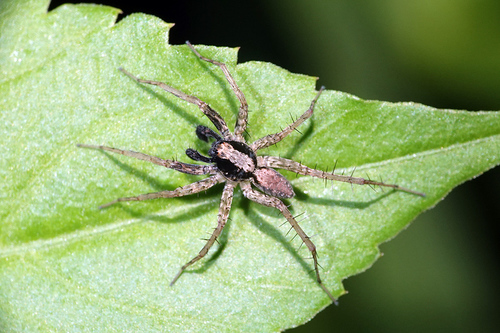
About Pardosa laura Karsch, 1879
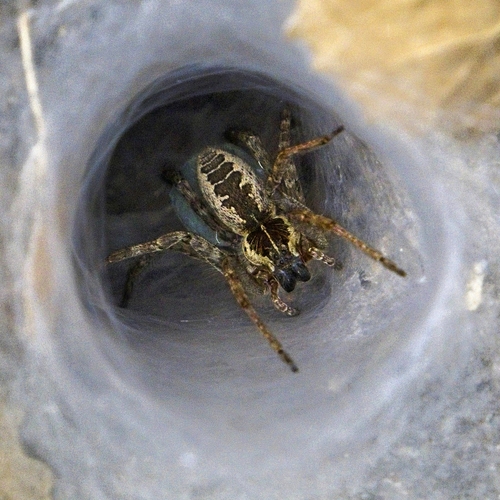
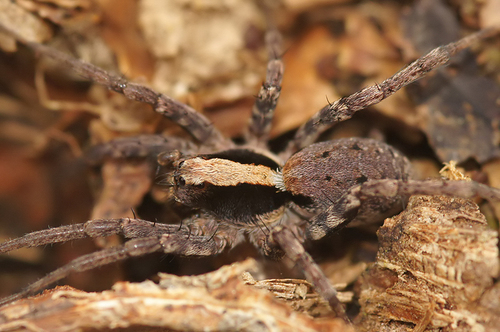
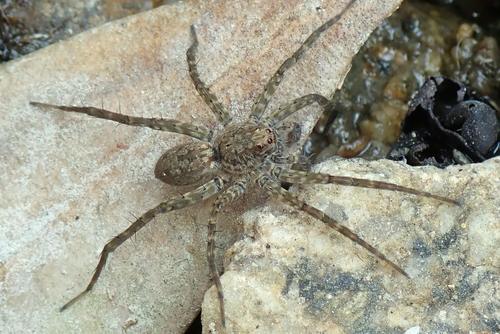
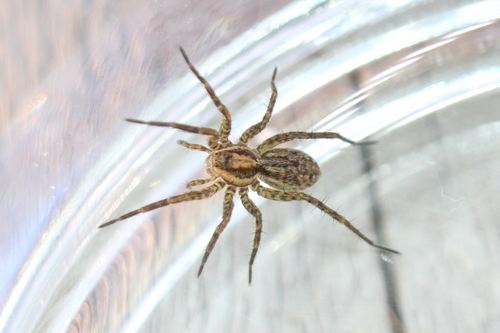
Pardosa laura Karsch, 1879 is a medium-sized wolf spider with clear sexual dimorphism in coloration. Adult females have a body length ranging from 4.0 to 7.2 mm, while adult males are smaller, with a body length between 3.7 and 5.2 mm. Females have a dark reddish-brown carapace, and males are almost entirely black. The anterior median eyes are slightly larger than the anterior lateral eyes. The clypeus is pale yellowish-brown, and is wider than the diameter of the anterior median eyes. The maxillae and labium are greyish-brown. For the sternum, females have a pale yellowish-brown sternum with a reddish-brown U-shaped marking in its central area, while males have a blackish-grey sternum with a narrow yellowish-brown longitudinal stripe in its upper central portion. The dorsal abdomen of females is yellowish-brown with irregular dark brown markings. Males have a reddish-brown abdomen, with six pairs of black spots arranged in rows on its posterior half. The legs are generally yellowish-brown, with ring patterns visible from the femur to the tibia. The only exceptions are the whitish-yellow coxae and the dark brown tips of the first leg patellae. The pedipalps are dark brown except for the yellowish-brown patella. There are white hairs at the tip of the femur and the base of the patella, and numerous black hairs at the tip of the tibia. This species is distributed across Russia’s Far East, Korea, Japan, China, and Taiwan. It is commonly found in mountainous grassland areas at the foot of hills and mountains, and also inhabits agricultural areas including rice fields and cotton fields throughout its range. Adult females of Pardosa laura can be found from May to mid-September, while males have a shorter active period from May to early July. Egg sac formation takes place in July.