About Pardirallus sanguinolentus (Swainson, 1838)
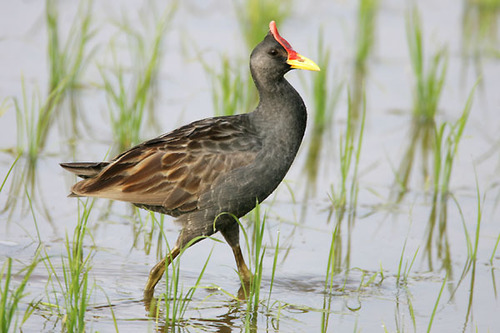
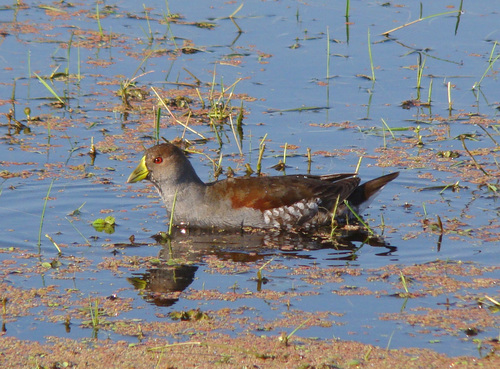
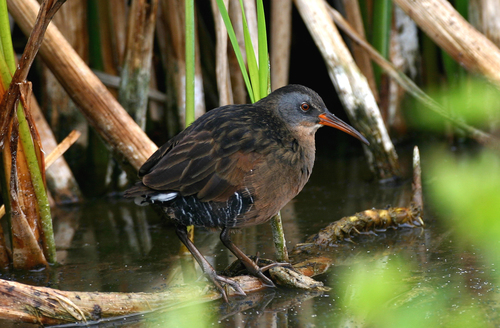
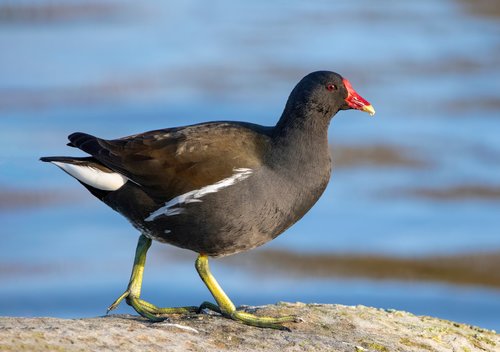
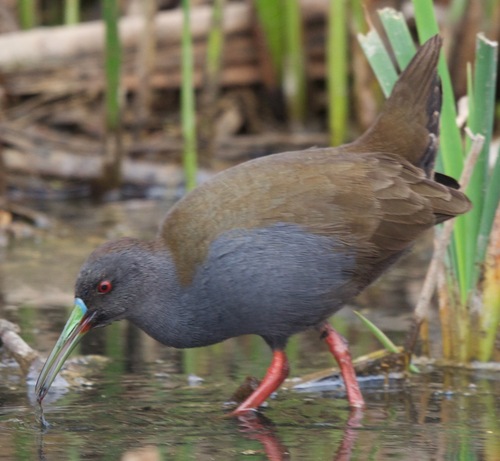
The blackish rail, scientifically named Pardirallus sanguinolentus (Swainson, 1838), is 30 to 38 cm (12 to 15 in) long and weighs 170 to 230 g (6.0 to 8.1 oz). Males and females have identical plumage and markings. All individuals of the species have red eyes and red legs, with a green bill. For all subspecies except P. s. luridus, the maxilla has a sky blue base, and the mandible has a bright red base. The nominate subspecies P. s. sanguinolentus has mottled brown upperparts and plain gray on the face and underparts. Other subspecies differ slightly in size and plumage: P. s. luridus is the largest, while P. s. zelebori is the smallest. P. s. simonsi has more olive-brown upperparts and paler gray underparts than the nominate. P. s. tschudii also has paler underparts than the nominate. P. s. landbecki has more olive-brown upperparts than the nominate and lacks mottling. P. s. luridus has no mottling on its upperparts and paler gray underparts than the nominate. This species, also called the plumbeous rail, is divided into six subspecies, each with a distinct distribution. The species occurs further south than any other South American rail. P. s. simonsi ranges from extreme southern Ecuador south along the Pacific slope through Peru into northern Chile. P. s. tschudii is found from southeastern Peru into central and southeastern Bolivia. P. s. zelebori occurs in southeastern Brazil. The nominate P. s. sanguinolentus is found in extreme southeastern Brazil, Paraguay, Uruguay, and Argentina as far south as Río Negro Province. P. s. landbecki lives in central Chile between the Atacama Region and Llanquihue Province, and extends into southwestern Argentina. P. s. luridus is found in southern Chile and Argentina, including Tierra del Fuego, and occurs as a vagrant on the Falkland Islands. The plumbeous rail lives in a variety of landscapes that have both water and vegetative cover. Examples of its habitat include even small reed marshes, ponds with floating vegetation, irrigated croplands, wet ditches through pasture, and oases in arid areas. Most of the species' population occurs in lowlands, but its range extends as high as 2,500 m (8,200 ft) in some limited areas, and reaches up to about 4,000 m (13,000 ft) in a few locations.