About Pardachirus marmoratus (Lacepède, 1802)
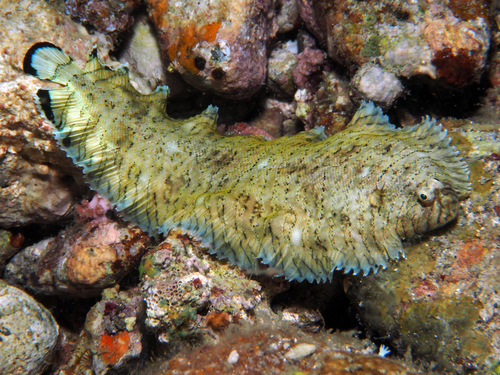
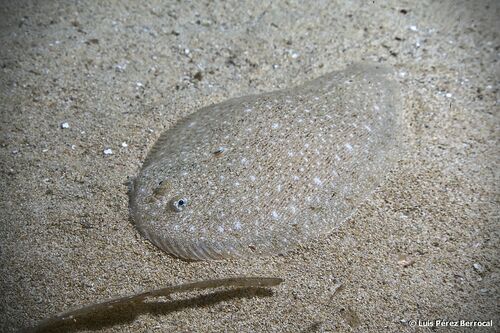
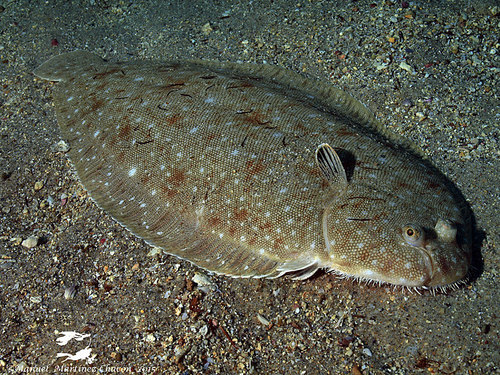
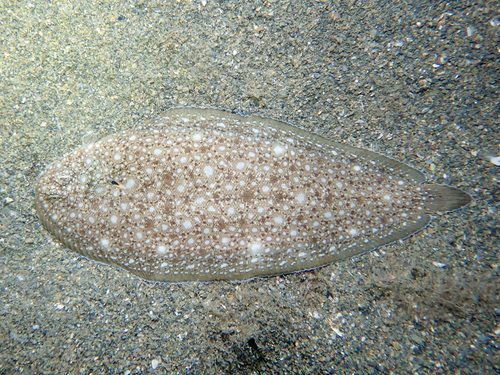
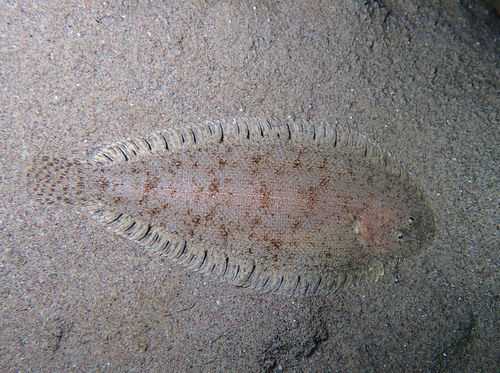
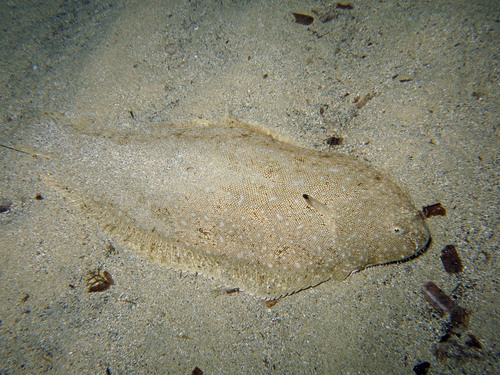
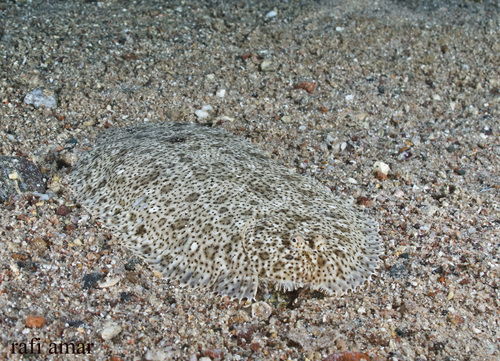
Juvenile Pardachirus marmoratus, the finless sole, are bilaterally symmetrical, with one eye on each side of the body. As they mature, their left eye migrates to the right side of the head, and their body becomes highly compressed, with a convex shape on the eyed side and a flat shape on the blind side. Their rounded caudal fin is not attached to either the dorsal or cloacal fin. This species has variable coloration: it is often whitish, pale brown, or pale grey, with scattered irregular dark brown ring-shaped markings and numerous dark brown spots across the head, body, and fins. Along the lateral line, there are typically two brown spots that contain yellow flecks. This coloration provides camouflage when the finless sole rests on sandy or pebbled seafloors.
Pardachirus marmoratus is found in the western Indian Ocean, ranging from the Red Sea to Sri Lanka, and along the east coast of Africa as far south as Durban. It inhabits shallow coastal waters with sand or mud seabeds, and often occurs near coral reefs. It feeds mainly on benthic invertebrates, and typically spends the day buried in sand, with only its eyes and nostrils visible. This species is caught for human consumption, marketed fresh, despite the toxic secretion it produces.
The finless sole secretes a milky ichthyotoxin from the base of its dorsal and cloacal fins. This secretion contains pardaxin, a lipophilic peptide that causes severe plasma membrane disruption leading to cell leakage. The pardaxin-containing secretion acts as a defense against predators including sharks; pardaxin irritates predator fish, and particularly affects their sensitive gills. Much of the early research on this species was conducted by Eugenie Clark. Pardaxin is of significant biotechnological interest: early research focused on its potential use as a shark repellent, while newer research examines the antimicrobial and neurotoxic potential of pardaxin and its analogs. One of the toxins produced, pardaxin-1, has unusual shark repellent and surfactant properties. It forms voltage-dependent, ion-permeable channels in membranes, and causes lysis of cell membranes at high concentrations. Pardaxin-1 has been shown to be 5 to 10 times more toxic, more cytolytic, and more active at forming pores in cell membranes than the other toxin secreted by this species, pardaxin-2.
Mimic octopuses have been recorded mimicking the finless sole by copying its shape, color, and texture; these octopuses also mimic venomous sea snakes and other fish.