About Parcoblatta uhleriana (Saussure, 1862)
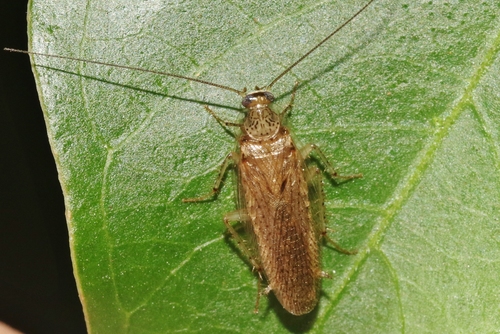
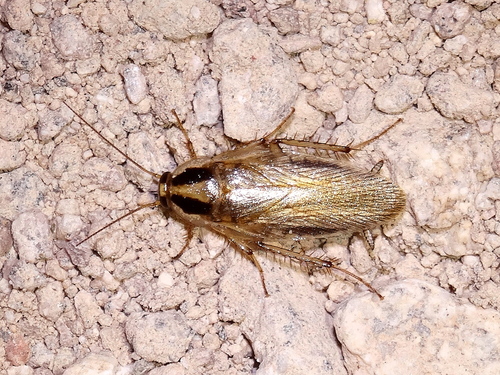
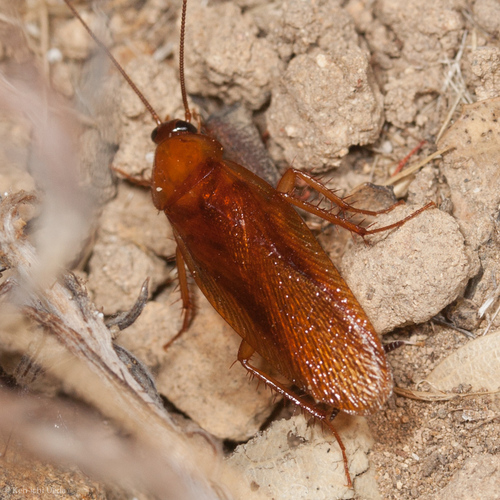
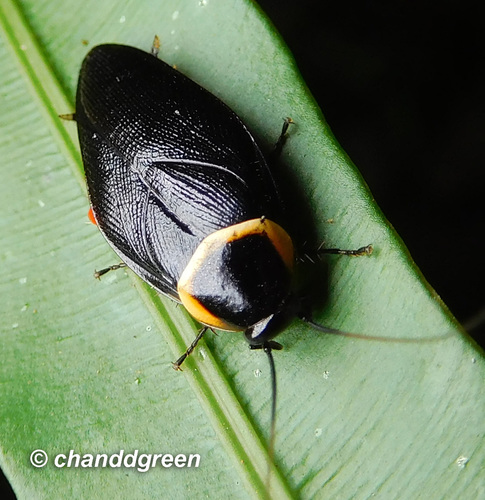
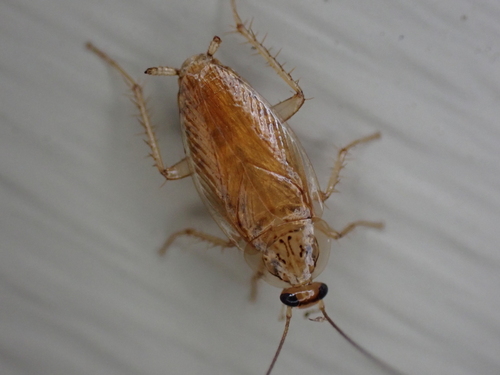
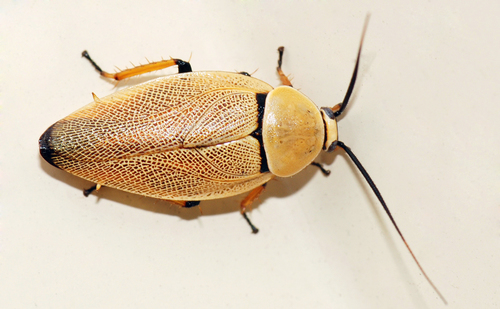
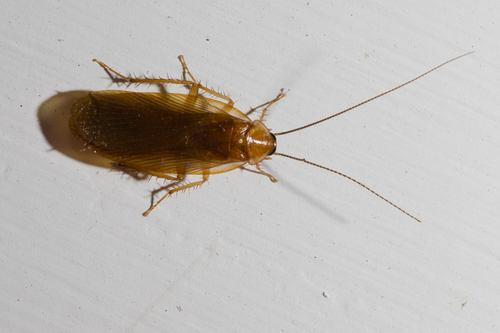
Parcoblatta uhleriana (Saussure, 1862) shows distinct sexual dimorphism in physical traits. Male individuals of this species are mostly uniform pale brownish-yellow, with slightly darker outer forewings called tegmina. They have a relatively slender body, a broad head, and a brownish stripe running downward from the middle of their eyes. Their pronotum, the shield-like structure behind the head, is nearly elliptical, widest at the middle, and has rounded angles. Female coloration is more variable; most individuals are shining blackish-brown, and some are dark reddish-brown except for the abdomen. Most of the female's legs, plus the edges of its tegmina, are chestnut brown. Females have a broader body and wider head than males. Their pronotum is nearly round, widest near the base. Their tegmina reach at most the second abdominal segment, and their wings are rudimentary. Females are easy to distinguish from closely related species by their short, separated tegmina and shining black color, while males are harder to separate from P. fulvescens and P. virginica. The species' ootheca, or egg case, is typically 3.4–3.5 mm (0.13–0.14 in) wide, with reported lengths ranging from 6–9 mm (0.24–0.35 in). It has a row of small, evenly spaced conical projections, which marks it as an entirely different type from any other known species in the Parcoblatta genus. This species is distributed only in Ontario, Canada and the eastern United States; the confirmed U.S. states where it occurs are Alabama, Connecticut, Delaware, District of Columbia, Florida, Georgia, Illinois, Indiana, Iowa, Kansas, Maryland, Massachusetts, Michigan, Mississippi, Missouri, New Jersey, New York, North Carolina, South Carolina, Pennsylvania, Tennessee, and Virginia. Parcoblatta uhleriana is classed as a dense deciduous forest species that prefers microhabitats with deep, moist leaf mold and plant litter. It can also be found along the borders of wooded areas and in suburban areas. It is often encountered beneath dry or damp leaves, pine needles, and other debris, under loose bark, inside decaying logs, on foliage or grass, and on roads at night. A study of habitat preferences in Kansas found that in forested areas, females were usually observed on the ground, while males were primarily found on bushes, though they also occurred on the ground or in grass. In disturbed areas, females also moved on the ground, while males were usually seen on or flying to blades of grass. In forest areas, males were found at a mean height of 71 cm, compared to 42 cm in nonforest areas; females were found at a mean height of 7 cm in forest areas, and 5 cm in nonforest areas. A survey of ants and cockroaches outside suburban houses in the Raleigh, North Carolina area found that P. uhleriana was the most frequently caught cockroach species in soil-level pitfall traps.