About Parcoblatta americana (Scudder, 1900)
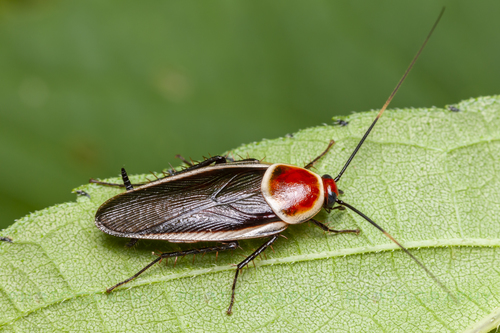
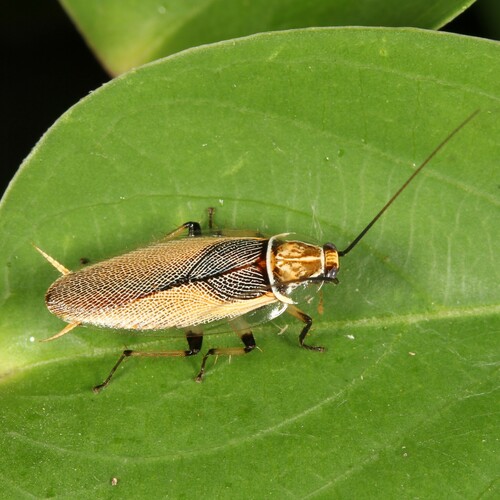
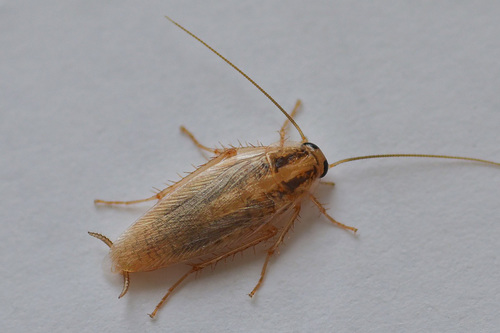
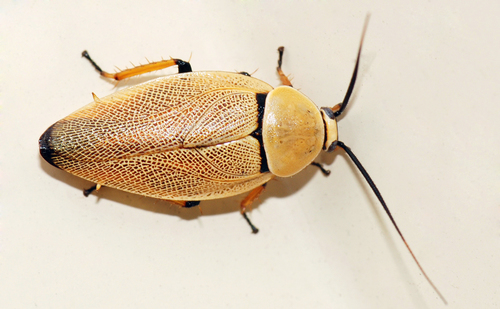
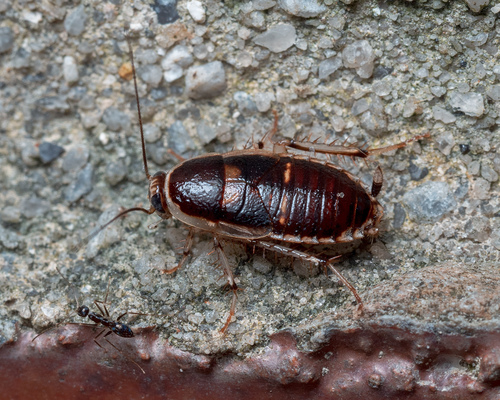
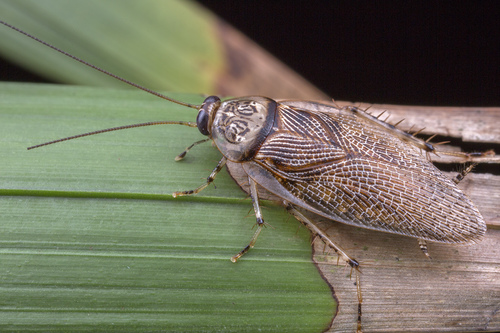
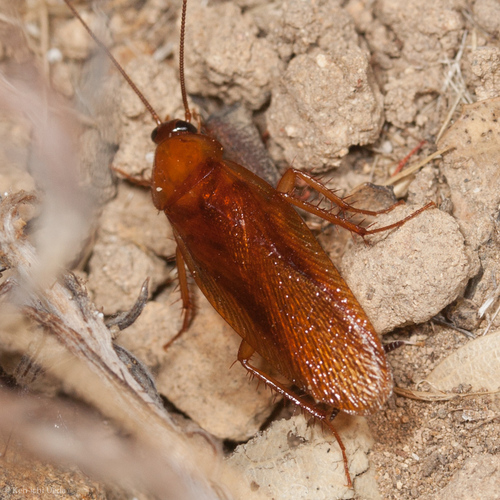
Parcoblatta americana displays notable size and color variation, which is thought to be caused by environmental conditions, especially the effect of aridity. Males of this species have fully developed, normal tegmina and wings, along with a tuft of hairs on the dorsal side of their middle abdomen. Male overall coloration can range from shiny dark brown or blackish to pale yellowish to lightly reddish tan. Across all color variations, the tegmina are translucent, and the ocelli (simple eye spots) are yellowish tan. Females of the species have extremely reduced tegmina that only appear as lobe-shaped lateral pads, and they lack hind wings entirely. Female overall coloration ranges from shiny reddish orange or brown, which is slightly darker on the back of the abdomen, to shiny dark brown, or shiny black with blackish brown underparts. Across all female color variations, the ocelli are tannish. Morgan Hebard's 1917 description of the species included measurement ranges based on 14 male specimens and 7 female specimens. Regarding distinguishing characteristics, male P. americana have a single specialized feature on the back of the median abdominal segment: a tuft of agglutinated hairs. Only one other male Parcoblatta species, Parcoblatta zebra, shares this trait. In P. americana, the tuft is small and quadrate (squarish), and the rest of the segment has very little specialization. In P. zebra, the tuft is much broader, and the rest of the segment has additional specialization. Male Parcoblatta virginica also has a single specialized area on its median abdominal segment, but instead of a tuft of agglutinated hairs, it has tiny hairs scattered across a large specialized area on the back of the segment. Among female Parcoblatta, only female Parcoblatta bolliana shares P. americana's trait of having greatly reduced tegmina and no hind wings. Female P. bolliana can be told apart from P. americana by its compact body shape, the distance between its compound eyes being smaller than the distance between its antennal sockets, its tegmina having almost no visible venation, and its supra-anal plate being weakly produced with side edges that converge to a broadly rounded apex. In comparison, P. americana females have a typical, less compact body shape, the distance between their compound eyes is noticeably wider than the distance between their antennal sockets, their tegmina have visible venation, and their supra-anal plate is normally produced with side edges that converge to a sharply rounded apex. This species is found in Mexico and the western United States, including the states of Oregon, California, Nevada, and Arizona. It has also been recorded inside a home in Klickitat County, Washington. Both sexes of P. americana live in the nests of Veromessor chicoensis (a harvester ant also classified as Messor chicoensis). They stay in these nests during the day, and emerge at night to feed on debris in the pile surrounding the nest. P. americana nymphs have been collected from pack rat nests (genus Neotoma) in Orange County, California. The species has been observed feeding on an apple growing six feet above the ground. In a study area in California's Santa Monica Mountains, the species was found to be fairly common but restricted to a localized area. The study recorded the species occurring in chaparral, grassland, oak woodland, and coastal sage (Artemisia californica), with adults present from early to mid summer. Females and nymphs live on the ground, and can be found under rocks, in rotting wood, and inside ant nests. Adult males live separately from females and nymphs; they are attracted to light, and will sometimes perch on chaparral plants at night.