About Parazoanthus swiftii (Duchassaing de Fonbressin & Michelotti, 1860)
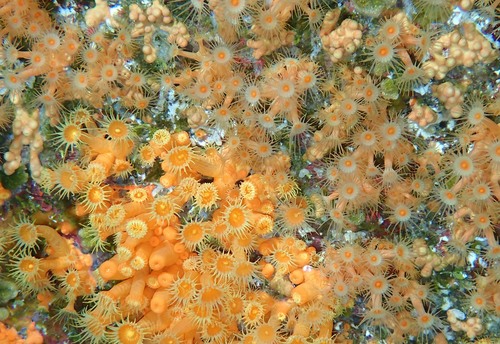
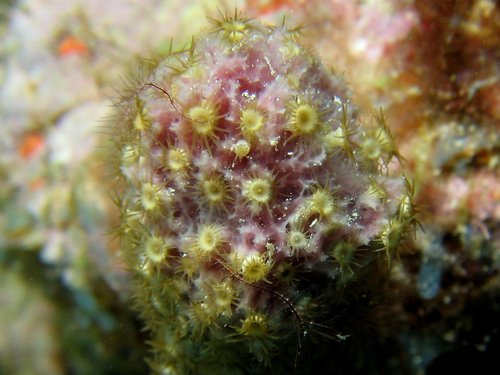
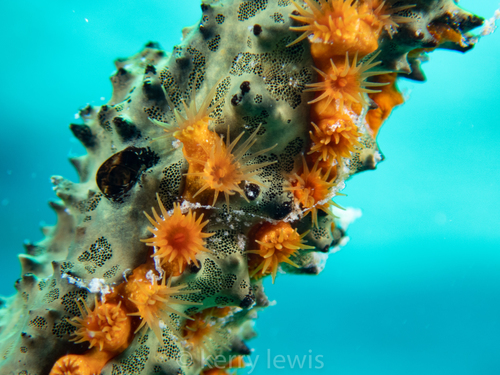
The golden zoanthid, Parazoanthus swiftii, is a colonial coral. It grows in small irregular groups and winding linear rows across the surface of its host sponge. It does not produce a calcareous skeleton, and its individual polyps are connected by a membranous basal structure. Each polyp resembles a small sea anemone, is orange or bright yellow in color, and measures approximately 0.6 centimetres (0.24 in) in diameter. Polyps have a slender column and up to twenty-six long, thin, pale yellow tentacles. This coral can cover as much as half the surface of its host sponge, and a single colony can contain up to 200 polyps. The golden zoanthid is common in the Caribbean Sea and around the Bahamas, and is also recorded from Jamaica, Puerto Rico, and the Virgin Islands. It mostly occurs at depths between 10 and 20 metres (33 and 66 ft), and occasionally grows in shallower water. It always grows as a colonist on living sponges, most often the brown tube sponge Agelas conifera, the green finger sponge Iotrochota birotulata, or the pink or brown sponge Topsentia ophiraphidites. It is typically found in sandy or silty locations.