About Paratrechina longicornis (Latreille, 1802)
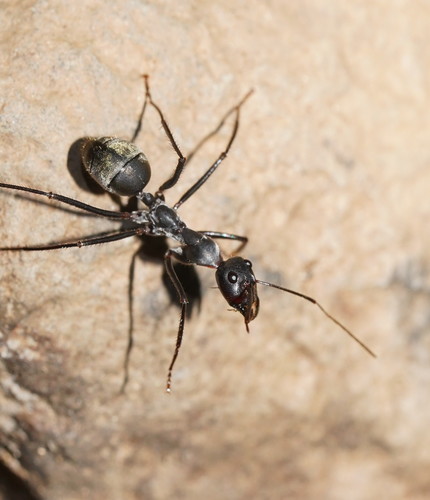
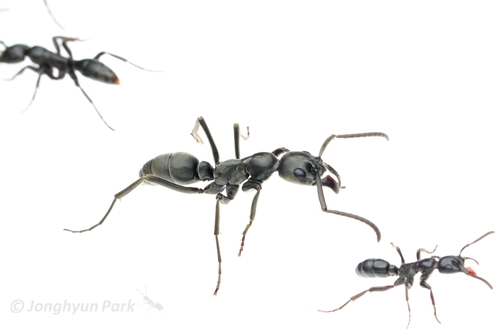
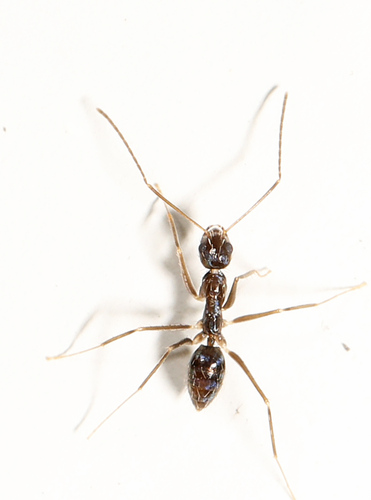
Paratrechina longicornis, commonly known as the longhorn crazy ant, has worker individuals measuring about 2.3 to 3.0 mm (0.09 to 0.12 in) long. Workers have brownish-black heads, thoraxes, petioles, and gasters, often with a faint blue iridescence. The body bears a few short, whitish bristles, and the antennae and limbs are pale brown. It is easy to distinguish this species from other members of the genus Paratrechina due to its unusually long antennae and legs. The first segment of each antenna is more than twice as long as the distance between its base and the back edge of the head. The eyes are elliptical and positioned far back on the head. This ant does not have a sting, but it can bite, then curve its abdomen forward to secrete formic acid onto prey. Its bite and secretion are too feeble to harm humans. A characteristic trait of this ant is the jerky, apparently random movement of workers, which is how it earned its common name. The genus Paratrechina probably originated in tropical Africa. The species has spread to temperate regions across the globe via human interference, and is now present in North America, South America, Africa, Europe, Asia, and Oceania. It is a tropical species, but its ability to live in disturbed and artificial habitats, inside buildings, and in urban areas has allowed it to spread north to Estonia and Sweden, and south to New Zealand. In the United States, it occurs outdoors across most of the country's southeast, and is found indoors in buildings and warehouses in California, Arizona, and the eastern seaboard. In tropical and subtropical areas, in addition to buildings, it can be found in gardens, coastal scrub, lowland rainforest, dry forest, savannah shrubland, and alongside roads, at elevations up to 1,765 m (5,791 ft), with an average elevation of 175 m (574 ft). It is considered both an agricultural and domestic pest in most of the tropics and subtropics, and an indoor pest in temperate areas. It is said to be the most widespread ant species in the world, though the pharaoh ant (Monomorium pharaonis) is also considered a contender for this title. Colonies of longhorn crazy ants build their nests in a wide range of both dry and damp sites. Nest locations include inside hollow trees, under loose bark, in rotten wood, under logs or stones, among rubbish, and under undisturbed debris inside buildings. The species thrives in convenience stores, gas stations, apartment blocks, schools, and cafés. Workers emerge to forage, and the nest location can be identified by observing ants carrying food back to the colony. These ants are omnivorous, feeding on seeds, dead invertebrates, honeydew, plant secretions, fruit, and a variety of household scraps. Large food items may be moved by multiple ants working together. They consume honeydew predominantly in spring and autumn, and may tend aphids, mealybugs, and scale insects to maximize the amount of these secretions they obtain. During summer, they preferentially seek out a high-protein diet. Inside buildings, they collect crumbs and insect corpses found under lights. The longhorn crazy ant is able to invade new habitats and outcompete other ant species. In 1991, no particular ant species was dominant in the large closed dome of Biosphere 2, a research station in the Arizona Desert. By 1996, the longhorn crazy ant had virtually replaced all other ant species present. It fed almost exclusively on honeydew secreted by the abundant scale insects and mealybugs in the dome, and populations of other invertebrates were greatly reduced. The remaining invertebrates were either well armoured, such as millipedes and woodlice, or tiny and underground-dwelling, such as springtails and mites. The inquiline wingless ant cricket (Myrmecophilus americanus) is often found living in longhorn crazy ant nests, and is kleptoparasitic on the ants, stealing food scraps brought back by workers and encouraging workers to regurgitate food for it to eat. This symbiosis may be aided by mimicry, as the cricket resembles the queen's gaster in both size and shape. A few poorly understood fungal species have been found associated with crazy ants in South America. In tropical regions, male and female sexual forms may appear outside colonies at any time of year, but in Florida they appear between May and September. On warm damp evenings, large numbers of males may emerge from the nest and move over the ground. At the same time, workers congregate on nearby vegetation, and periodically a wingless female emerges from the nest. Mating is difficult to observe in the constantly moving mass of ants. Though males are capable of flight, nuptial flights do not occur. On other occasions, massive numbers of workers sometimes emerge from colonies and cover the ground completely. Large areas may be covered by a continuous layer of workers, many carrying brood, with many wingless females scattered among the workers. The reasons for these gatherings remain unclear. Longhorn crazy ants are able to mate with their siblings without showing any of the typical negative effects of inbreeding. While the queen produces workers through normal sexual reproduction, daughter queens are genetic clones of the queen, and sons are genetic clones of the queen's mate. This means the male and female gene pools remain completely separate, assuming workers never reproduce, and this has allowed the longhorn crazy ant to become one of the most widespread invasive species in the tropics. This reproductive process is known as double cloning, and was discovered by evolutionary biologist Morgan Pearcy of the Université libre de Bruxelles. This species apparently undergoes three larval moults. Its larvae are hairy and have a unique morphology; male larvae can be easily distinguished from larvae that will develop into workers by their longer, more abundant hair-like pilosity.