About Paratrechina fulva (Mayr, 1862)
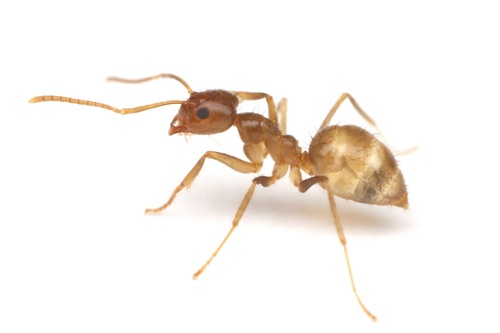
Adults of this ant species reach approximately 3 millimeters, or one eighth of an inch in length, making them smaller than the red imported fire ant, Solenopsis invicta. Their bodies are covered in reddish-brown hairs. The species' larvae are plump and hairy, with a specific mouthpart conformation and unique mandible shape that enables precise species identification. Colonies of this ant do not build centralized nests, beds, or mounds, and instead reside under stones or debris piles. These ants tend aphids to obtain honeydew, feed on small insects and vertebrates, and forage on plants, particularly in search of sweet substances. The species favors the warm, moist conditions found in coastal areas. Nylanderia fulva, which is also known as the tawny crazy ant, has acted as a pest in rural and urban areas of Colombia and across South America, where it has displaced all other native ant species. In affected regions, small poultry such as chickens have died from asphyxiation from these ants, while larger animals like cattle are attacked around the eyes, nostrils, and hooves. Local grasslands have dried out because the ants cultivate plant-sucking hemipteran pests to harvest their excreted sugary honeydew, and increases in these hemipterans damage the vegetation. When threatened, this ant, like other formicine ants, can bite but cannot sting. It excretes formic acid through a hairy circular structure called an acidopore at the tip of its abdomen, which it uses as venom. This formic acid causes very minor pain that fades quickly. Formic acid gets its name from the Latin word formica, meaning ant, because the compound was first distilled from ants in the 17th century. Uniquely, this tawny ant uses its own formic acid as an antidote to the venom alkaloids called solenopsins produced by fire ants. Fire ant venom alkaloids have been shown to be strongly paralytic to competing ant species, so tawny crazy ants may have evolved this resistance by immobilizing fire ant venom toxins with acid. Tawny crazy ants have been documented displacing other ant species in their native Argentina, and later in the United States, including the red imported fire ant. This displacement was initially assumed to be caused by exploitative and interference competition. The earliest recorded observation of Nylanderia fulva in the United States comes from Brownsville, Texas in 1938. By the early 2000s, the ants had spread across the southeastern region of Texas, covering more than 27 counties. Large population outbreaks have also been recorded on St Croix in the United States Virgin Islands, where the species was often misidentified as its close relative, the hairy crazy ant Nylanderia pubens. As of 2012, the ants had established breeding colonies in every state along the United States Gulf Coast. This ant is classified as an invasive species. As of 2021, established populations of Nylanderia fulva in the United States are restricted to some southern portions of the country.