About Parastrellus hesperus (H.Allen, 1864)
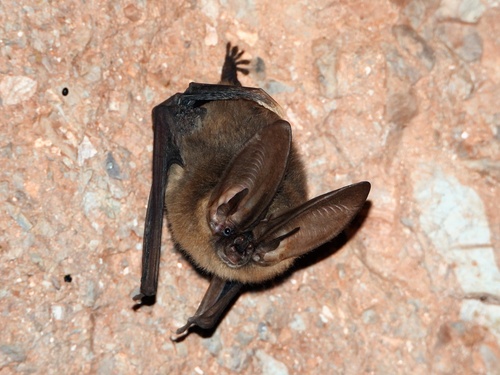
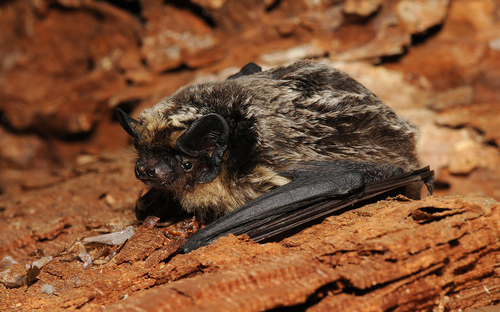
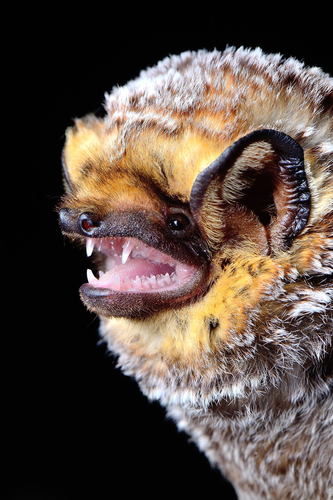
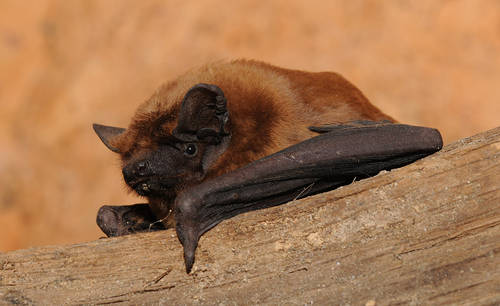
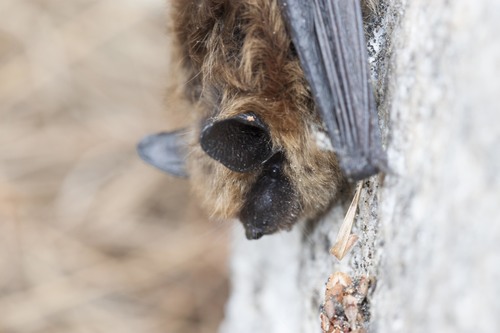
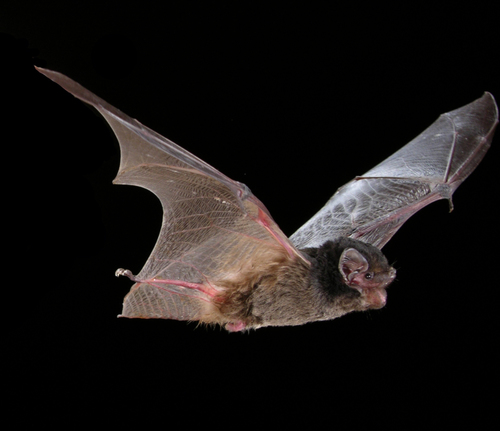
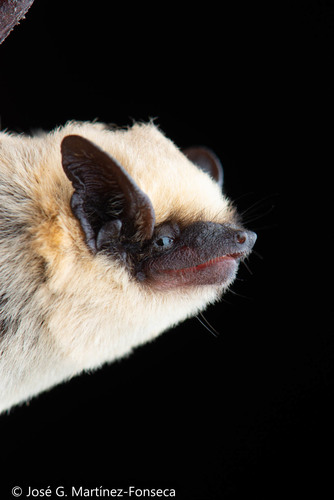
Parastrellus hesperus (H.Allen, 1864) is the smallest bat species in the United States. It has a wingspan of 190–215 millimetres (7.5–8.5 in) and a body length of 62–80 millimetres (2.4–3.1 in). Its tail measures 29–30 millimetres (1.1–1.2 in), hind feet 5 millimetres (0.20 in), and ears 9 millimetres (0.35 in). On average, females of this species are slightly larger than males. P. hesperus has a color range from white to pale yellow to dark brown, and exhibits counter shading: it is dark on its upper side and lighter on the underside. Its face, ears, feet, and flight membranes are usually very dark, almost black. Its pelage is 3–4 millimetres (0.12–0.16 in) long, full and soft. All hair shafts have black bases, with distal portions fading to lighter shades. The wings of P. hesperus are hairless except for the lower third of the interfemoral membrane, and its toes also have a light sprinkling of fine hairs. Its wings are short and broad, forming a low-aspect wing that allows it to fly at speeds as low as 8.0 kilometres per hour (5 mph). It has a short, broad head, short ears, and a small, club-shaped tragus, and weighs 3–6 grams (0.10 – 0.21 oz).
In terms of distribution and habitat, P. hesperus lives in deserts and lowlands of the western United States and Mexico. While it is most commonly found in the deserts of the southwestern U.S., its range extends north to the state of Washington and south to the Mexican states of Michoacan and Hidalgo. An isolated population has been recorded in north-central Texas and Oklahoma. These bats prefer lowlands, and are usually the most common bats found below 5,000 feet of elevation within their range. During the day, rock crevices are the preferred roosting sites for P. hesperus, though some individuals have been found roosting in crevices inside mines. They may also be found in buildings, under rocks, and in dense sedge growths, but these roosting sites are used much less frequently than the preferred rocky crevices. Due to their small size, P. hesperus is vulnerable to dehydration and desiccation. Individuals living in barren desert areas with no trees or rocky outcroppings must find a suitably sheltered roost to spend daylight hours, or they will risk death. One hypothesis suggests P. hesperus spends days in kangaroo rat burrows, but there is currently no evidence to support this claim. In some areas, they may roost in rock piles used to anchor soil at the bases of highway and railroad embankments.
Regarding behavior and reproduction, Parastrellus hesperus is typically the first bat active in the evening and the last bat visible after sunrise. It is most active in the hours immediately after sunset and right before sunrise, and is usually inactive during overnight hours. On rare occasions, P. hesperus has been observed flying in full sunlight during late morning. P. hesperus is an insectivorous bat, and its flight is erratic and fluttery. Its low-aspect wings give it increased maneuverability, which is important for hunting flying insects. It forages in open areas above small trees. P. hesperus enters hibernation when the weather turns cold or food supplies decrease. However, both male and female individuals sometimes emerge to hunt during winter months, though not in the numbers commonly seen in warmer seasons. P. hesperus hibernates in mines, caves, and rocky crevices. It is not known to hibernate in large groups, and is usually found alone when hibernating. Female P. hesperus give birth in June. They usually have two young per mating, but may only produce one. In line with its mostly solitary nature, females raise their young alone or in small maternity colonies of no more than a dozen bats. Young are typically capable of flight within 2–3 weeks after birth.