About Parasa lepida (Cramer, 1779)
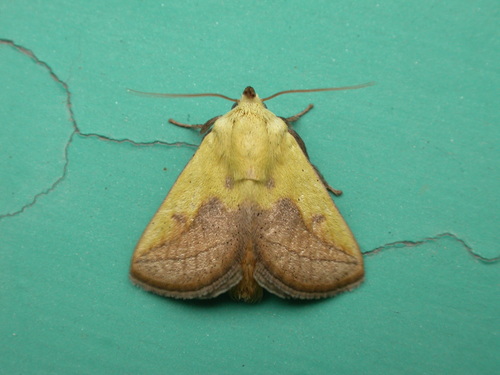
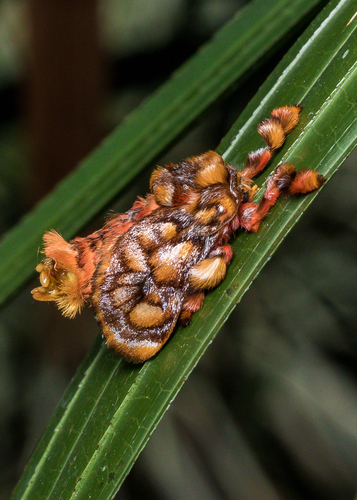
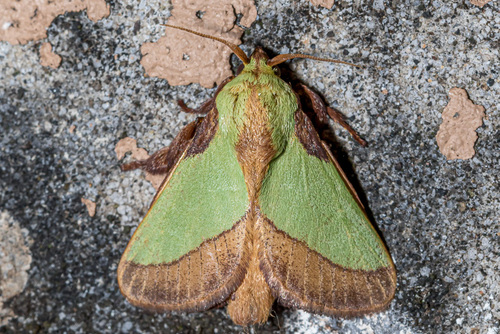
Parasa lepida (Cramer, 1779) shows distinct sexual dimorphism in adult physical characteristics. In males, the head is greenish with red-brown coloration along the sides, the thorax is green with a brown stripe on the vertex, and the abdomen is brown. Forewings are pale green, matching the color of a pea plant, with a red-brown basal patch on the costa. The outer area of the forewing is reddish brown, and is widest at the inner margin. Hindwings are yellowish at the base and turn reddish brown toward the margin, and leg joints have pale tips. In females, the reddish-brown stripe on the thorax is much wider, and nearly the entire hindwing is reddish brown. The larva has a pale green, whitish, or bright yellowish green dorsal surface, with three green bands running along the full length of its body. It has sub-dorsal and sub-lateral series of short spinous tubercles, and the spines of its anterior and posterior tubercles are tipped with red. The cocoon is purple brown. Eggs are flat, overlap one another, and are covered by a transparent cement. Regarding its ecology, the egg stage lasts six days, the larval stage lasts forty days, and the pupal stage lasts twenty-two days, though these durations may fluctuate with climatic changes. Larvae of this species are considered pests, and have been recorded feeding on a range of commercial crops: coffee, rubber, oil palm, cocoa, cassava, tea, ebony, coconut, gliricidia, banana, winged bean, and mango. Females emit the semiochemical pheromone (Z)-7,9-Decadien-1-ol. The cuckoo wasp Chrysis shanghaiensis is a known parasite of Parasa lepida caterpillars. In August 1986, dead Parasa lepida larvae were found on coconut leaves from India; experiments confirmed that a multiple embedded baculovirus was the causative agent of the disease that killed the larvae.