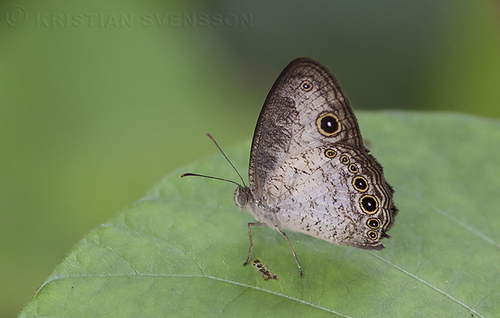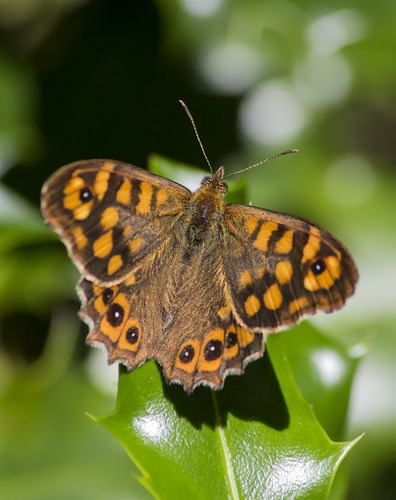
About Pararge aegeria (Linnaeus, 1758)
Pararge aegeria (Linnaeus, 1758), commonly called the speckled wood butterfly, has an average wingspan of 5.1 cm (2 in) for both males and females, though males are usually slightly smaller than females. Males have a row of grayish-brown scent scales on their forewings that females do not possess, and females have brighter, more distinct markings than males. Four subspecies are recognized, with distinct visible characteristics. The subspecies P. a. tircis has a brown base color with pale yellow or cream spots and darker upperwing eyespots. The subspecies P. a. aegeria has a more orange base background; its hindwing underside eyespots are reddish brown instead of black or dark gray. These two subspecies gradually intergrade into one another. The subspecies P. a. oblita is a darker brown, often close to black, with white spots instead of cream spots. The underside of its hindwings has a marginal pale purple band and a row of prominent white spots. The spots of subspecies P. a. insula are tawny orange rather than cream. The underside of its forewings holds patches of pale orange, and the underside of its hindwing has a purple-tinged band. Even with considerable variation within each subspecies, identifying the different subspecies is possible. Morphology of this butterfly follows a gradient along its north-south geographic cline. Northern members of the species have larger overall size, greater adult body mass, and larger wing area; these measurements decrease when moving south across the species' range. Forewing length increases when moving north. This longer forewing in the north is an adaptation for thermoregulation in the cooler temperatures of the northern part of the species' range. Northern butterflies are also darker than southern ones, forming a continuous coloration gradient along the geographic cline. The speckled wood occupies a wide range of grassy, flowery habitats including forests, meadow steppes, woods, and glades. It can also occur in urban areas alongside hedges, in wooded urban parks, and occasionally in gardens. Across its range, it typically prefers damp areas. It is generally found in woodland across most of the Palearctic realm. P. a. tircis occurs in northern and central Europe, Asia Minor, Syria, Russia, and central Asia. P. a. aegeria is found in southwestern Europe and North Africa. Two extra subspecies are found within the British Isles: the Scottish speckled wood P. a. oblita is restricted to Scotland and its surrounding isles, and the Isles of Scilly speckled wood P. a. insula is found only on the Isles of Scilly. For reproduction, female fecundity (the number of eggs produced) depends on body mass: females deprived of sucrose during their oviposition period have reduced fecundity, so heavier females produce larger numbers of eggs. Beyond body mass, the number of eggs a female lays may also relate to the amount of time she spends searching for an oviposition site. The number of eggs laid is inversely proportional to individual egg size. Experiments have found that egg size has no influence on egg or larval survival, larval development time, or pupal weight. One proposed explanation is that there is a trade-off between the number of eggs laid and the time spent searching for an optimal oviposition site; in an optimal environment, a female can produce more eggs, leading to more offspring and increased reproductive fitness. Larval food plants are a variety of grass species. These include Agropyron in Lebanon, Brachypodium across the Palaearctic, Brachypodium sylvaticum in the British Isles, Bromus in Malta, Cynodon dactylon in Spain, Dactylis glomerata in the British Isles and Europe, Elymus repens in Lebanon, Elytrigia repens in Spain, Holcus lanatus in the British Isles, Hordeum in Malta, Melica nutans in Finland, Melica uniflora in Europe, Oryzopsis miliacea in Spain, Poa annua in Lebanon, Poa nemoralis in Czechia and Slovakia, and Poa trivialis in Czechia and Slovakia. The preferred grass species for larvae is couch grass, Elytrigia repens. Adult speckled wood butterflies feed on nectar.