About Parapoynx stagnalis (Zeller, 1852)
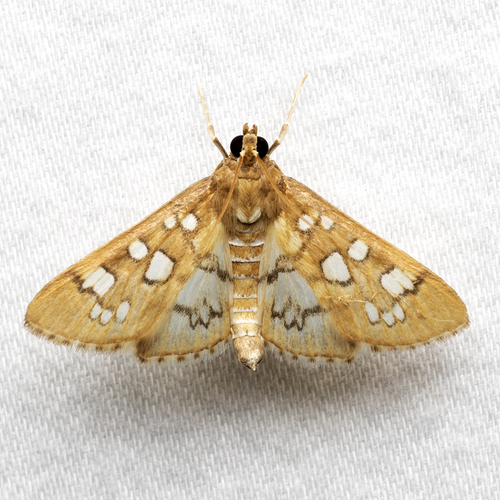
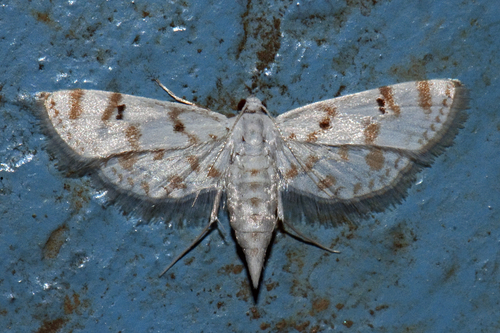
Parapoynx stagnalis, commonly known as the rice caseworm, completes its full life cycle in approximately 35 to 40 days. The forewings of adults reach 15 mm in length. Adult moths have whitish wings marked with pale brown wavy patterns, and each forewing bears two black comma-shaped marks. Males can be distinguished by a narrow, uniform abdomen, while females have an abdomen that is widest at the middle and tapers toward the posterior end. Females typically lay 150 eggs, and first instar larvae hatch one week after laying. The species has six larval instars total; the final instar emerges after 20 days and reaches a maximum length of 10 to 12 mm. Caterpillars have branched tubular gills that allow them to breathe in aquatic environments, so larval instars can disperse through water. Pupation takes place when the pupal case is attached to a leaf sheath above the water level. Adults emerge one week after pupation begins. As its common name suggests, the rice caseworm is a major pest of rice across the world. The larval stage is the infective stage: larvae cut leaf tips to construct leaf cases. Infestations can be identified by ladder-like skeletonized leaf tissue; larvae consume the entire leaf blade, leaving only the leaf midrib visible. Surrounding weeds act as secondary hosts for this moth.